
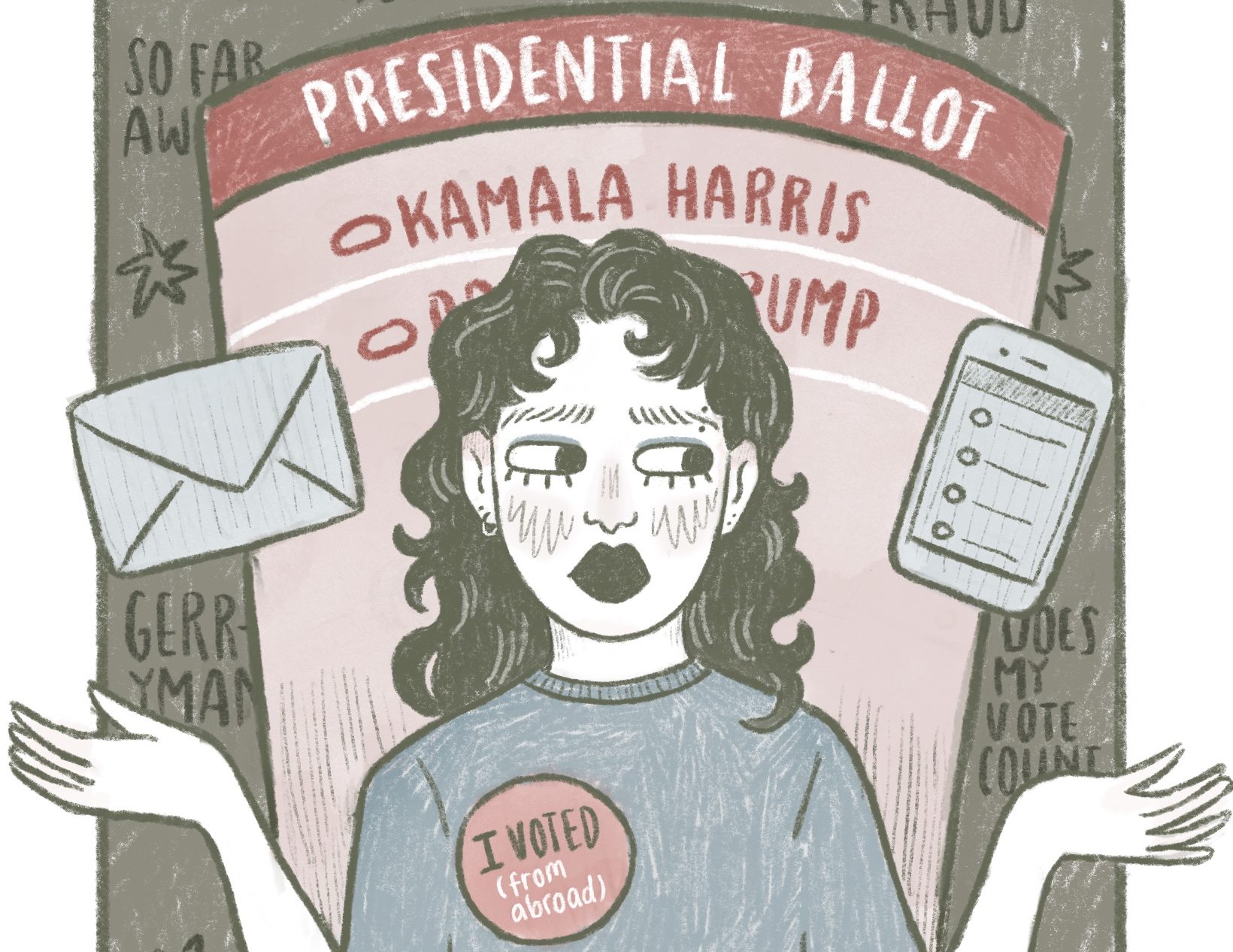
A college library in Dublin is not, on first glance, the most likely battleground for the US election. But, for Americans studying at Trinity this November, voting necessarily takes place far beyond the ballot box. Fourth year European Studies student Luna Michelis cast her vote for North Carolina – a swing state where Republicans have filed a lawsuit to make less people overseas eligible to vote – in the same place she might submit an essay: “Voting from the Ussher was quite surreal”.
Absentee voting rose massively in the 2020 election, with almost half of voters doing so mail-in or absentee. Though this increase was largely due to the pandemic, absentee voting has been a focus for Republicans and Democrats alike in this election cycle. Typically, a higher proportion of absentee ballots are votes for Democratic candidates, and Donald Trump has often claimed that mail-in votes are fraudulent.
This year, state Republican parties in places such as North Carolina, Georgia, Pennsylvania and Texas have attempted – in some cases successfully – to make the rules regarding absentee voting stricter. This includes limiting the time frame that absentee voters have to send in their ballot, increasing ID requirements and not counting undated ballots. In states such as Minnesota, there have been legal arguments over whether voters should be made aware if their mail-in ballots are rejected. However, Republicans are simultaneously trying to increase the amount of their supporters voting by mail, launching a $10 million campaign in Pennsylvania to encourage early and mail-in voting. If there is one thing that is predictable about the US election, it’s that it’s going to be confusing.
It’s not just my non-American status making me bewildered. When I meet with Political Science and History student Mary Woods at the Vote From Abroad stand in the Arts Block to ask about what it’s like to watch the election as an American student abroad, we pause our conversation frequently to accommodate students approaching the stand. While, in my experience, stands in the Arts Block tend to be avoided unless they proffer baked goods or free energy drinks, the Vote From Abroad table attracted a steady stream of students. They sought help with requesting an absentee ballot and filling out online forms, or came to the stand wondering how to be certain that their vote would be counted. Paid for by the Democratic Party but technically nonpartisan, Vote From Abroad seeks to facilitate voting absentee – for instance by helping international students make sure they are voting, as Woods is doing.
“Every state has different regulations,” explains Woods. “We also have a lot of Irish people who have never lived in the US but have citizenship, who can vote in some states but not all states, and [want to know] how you register if you’ve never lived in the US.” Add this to the fact that absentee ballots have to arrive in America well before the date of the election, and you can understand why a sometimes-simple process can be daunting for new voters. Questions about the election and interest in the build up to November 5th are, obviously, far from limited to those eligible to vote. Woods also works at the Book of Kells Experience where, she says, as soon as people realise she is from the US, they ask her about the election: “The Americans often tiptoe around it, but anyone who is not American is immediately [asking]: Who are you voting for?”
As someone who voted in person in England this summer, I assumed that watching such a crucial political moment over four thousand miles from home must be bizarre. Being so involved in absentee voting, however, has been a “really hopeful” experience for Woods. “It can be a little bit isolating to vote from abroad and you feel like you’re not in the thick of things, but I think that that’s made people reach out more and try to build that community here at Trinity.” She has been amazed by the amount of interest from people who, on first glance, might have no personal stake in the election: “I have been surprised by how many people are really excited to contribute if they see a way to do so.”
But being physically removed from the election can also make it appear removed from reality. Aisling Bourke, a Global Business student from New Jersey, explained that even though the election is a common conversation here, she still feels less involved in it due to her location: “because it is such a contentious race, especially with the attempts on Trump’s life, it almost feels like I’m watching a movie”. It is also strange, she says, “being around so many Americans who don’t necessarily feel they need to, or want to, vote”. Charlie Hastings, from South Carolina, also told me that he is “often around people who view the election as a sort of caricature as it doesn’t affect them directly”. This is “wacky”, he says, but also preferable to the intensity of having a front row seat to the election’s building intensity.
The emotional distance that some students feel as a result of geographical distance has been “frustrating” for some who want to engage in political discourse, such as Rose Heaney, from Minneapolis. “Even a lot of the Americans that I have talked to about the election seem to be apathetic towards it”, she said. In early October, she told me, “I don’t know many Americans at Trinity who have made a concrete voting plan, or plan to vote at all. I don’t know if it’s just an ‘out of sight, out of mind’ thing or if I’m just from somewhere with a higher voter turnout, but it’s definitely disheartening.” In contrast, Heaney, like Woods, has found that non-Americans around her are keen to talk about her national politics. “I don’t mind it as long as the person I’m discussing it with isn’t talking down to me about it”, she says, “I understand that American elections don’t just impact Americans, but it bothers me when non-Americans in Dublin try to explain the weight of the election. Trust me, I know!” Eóighan Noonan, a postgraduate student from New York, suggests that, in Ireland, “people just like talking about how crazy they think Donald Trump is”.
Michelis posits that feeling removed from the election is not just a matter of location, but one of privilege. Of watching the race from Ireland, she noted “I just feel a bit removed from it all which, to be fair, I am in every conceivable sense.” This didn’t only start once she moved to Ireland: “I was born and raised in an incredibly liberal bubble in California and have always been privileged enough to be in a position where I will have a stable life regardless of election outcomes by and large, so in that sense I always have been a bit removed.” This has not stopped her voting, though, and she was keen to caveat that “I do care deeply about the people who that is not the case for and my family and friends who live there and always will. I’ve never been especially patriotic but I don’t think you have to be to still care deeply about what happens to the place you were born and raised in.” This care has been tangibly tested in recent weeks for American students, who must now face the anticipation common to all letter-writers: waiting for an answer.

Leave a Reply