
“Dear Emily, how are you? Hope you’re well. We have come to the conclusion that for our more basic titles it makes sense to tap into ChatGPT and make our own adjustments internally to ensure the content ticks the boxes it should. Your work has been really appreciated. I’ll certainly be in touch but only if you are happy for me to do so on a more adhoc basis. Thanks again, —”.
I wouldn’t describe myself as being ‘well’ after receiving this email and, along with it, the realisation that I had been fired from my copywriting job, muscled out by AI. No longer could I make an easy living writing about the ‘Top Motorhome Routes in Yellowstone’ or compiling ‘Ten Tips for Keen Topiarists’.
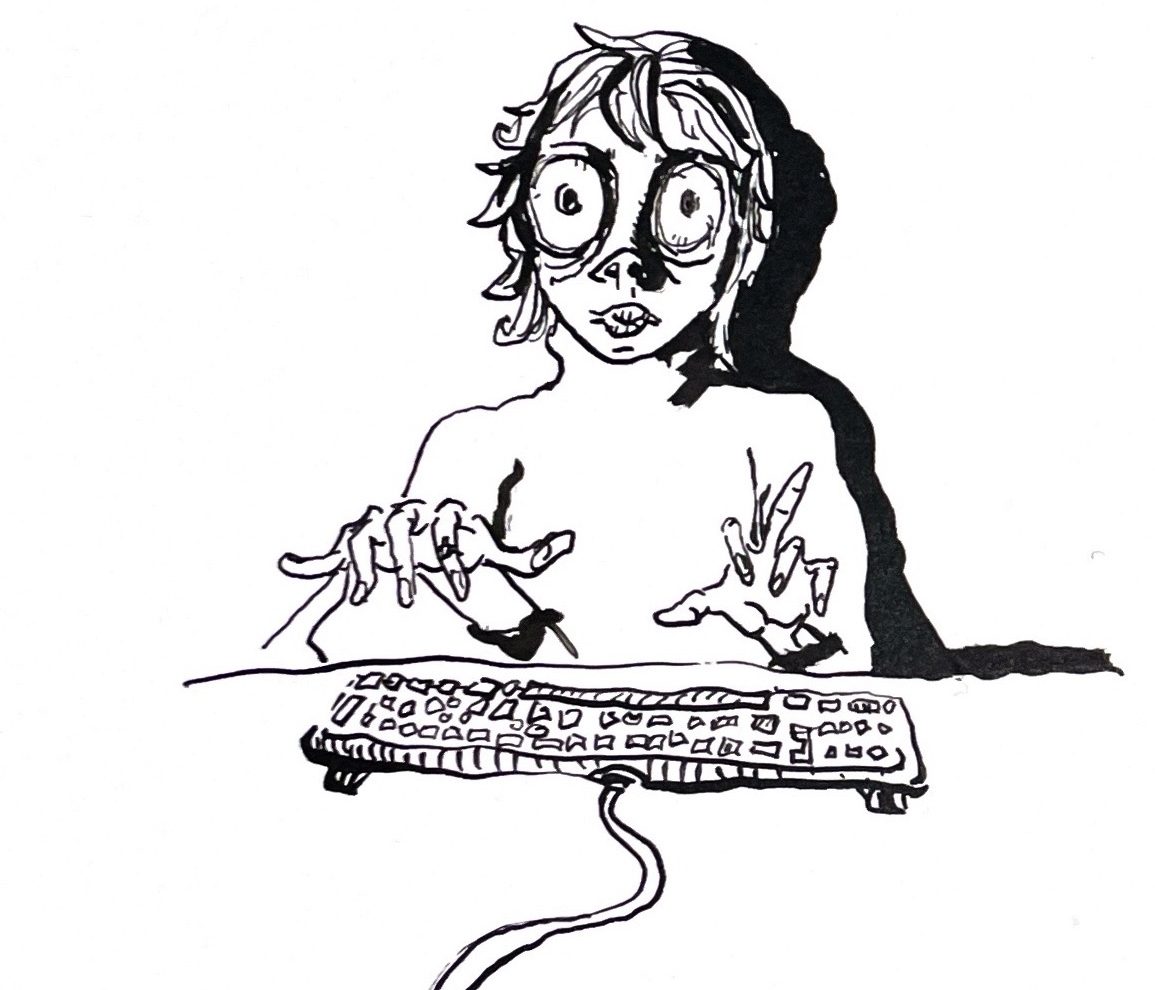
Maybe my reaction should have been to worry about the future of humanity, to lament the outsourcing of my mental functions to a machine. But, strangely, my mind didn’t wander to these existential corners. Instead, a disconcerting realisation set in. A realisation that I had been replaced so easily by a machine (if I can call it that) because I had spent a year working as a machine (and not in the positive sense). I’d simply been typing my titles into Google and reshaping the results into hyperbolic, cringeworthy prose. I had exercised no skill beyond that of ChatGPT’s algorithm. In fact, I’d been working at a far slower pace, and charging a much higher fee.
By now, we all have a basic idea of what ChatGPT is and how it works. Of course, OpenAI’s creation isn’t the only generative AI on the market, but the name seems to have become shorthand for the technology. In longhand, ChatGPT becomes the catchy ‘Chat Generative Pre-trained Transformer’. The first stage of its training is exactly what you would imagine, with creators feeding in information, or ‘data’, gathered from the internet’s library of websites, articles, and books. I cottoned onto the second stage of its training in a strange turn of events; trawling through LinkedIn for a new job post-firing, I noticed that half of those on offer were asking me to take part in a process called RLHF. As it turns out, this similarly catchy acronym stands for Reinforcement Learning from Human Feedback. Yes, I was being asked to train ChatGPT. In my defiant state of mind, perhaps the only thing worse than working as an AI would be training an AI.
I’m not the only one to lose out; Goldman Sachs recently reported that AI is currently set to replace approximately 300 million full-time jobs in the next 10 years. This trend of machines supplanting the quantitative skills of humans seems to be exemplified, even allegorised, in the case of the word ‘computer’. Coming from the Latin putare, it originally meant ‘to think’ (in the sense of calculating or balancing an account). It started to be used as a noun around the 17th century, when it referred to people who carried out calculations, whether simple or complex. The term wasn’t christened with its current meaning until the 1940s, following Alan Turing and his team’s work at Bletchley Park. Now, at least in my mind, the word provokes the image of a 2004-issued, cream-coloured box set desktop. To others it might be a laptop or gaming set-up. I highly doubt that anyone automatically pictures a human being when asked what a computer is. But, not so long ago, they would have.
Maybe in a couple of decades’ time we’ll picture a MacBook when someone asks us what a copywriter is. Maybe it will only take a couple of years. Terrifyingly, the reason it’s so easy for AI to replace these workers — for ChatGPT to strip me of my pocket-money — is because the daily tasks of a significant portion of the workforce require them to act as machines. Editing spreadsheets, identifying grammar mistakes, and scheduling social media posts are but a few of the tasks that require no human creativity or agency.
But surely creative jobs are vulnerable too, you might say. It depends how you define creativity, I would reply. The Classicist in me wants to cling to the fact that creativity is etymologically linked to the idea of creating something physical, whether that’s a vase or a child. As we know, Chat GPT doesn’t create, but ‘transforms’, moving pre-loaded information around into different shiny formats, artificial collages, if you will. I suppose this means that, to me, creativity is in originality, in channelling lived experience into work. And I’m optimistic that people will continue to want to know who’s at the end of the line, who’s on the other side of the poem, who’s the voice behind the article.
When racking my human brain for other jobs where people are worked like machines, I thought of Owen Jones’ condemnation of call centres in his book, Chavs: The Demonisation of the Working Class. Jones wrote about the often robotic daily routine of following scripts and being refused breaks. This mechanised way of working was designed to increase workforce efficiency, with Jones proposing that call centres are the new job markets for the working class. But his focus on their perpetuation of “the lack of workers’ autonomy in the workplace” felt pertinent to this issue, too: workplaces and school systems encourage workers and students alike to act as unconscious, uncreative, non-individual entities. We are taught to rote learn, paid to enact near-automated tasks.
I spoke to a current final year medical student at Oxford University, who volunteered at a medical call centre as part of her degree, to try and get a sense of the machine-like treatment of workers. She told me the experience was “incredibly draining”, that workers were “advised very specifically to use the exact wording on the script and not [to] change it at all, which makes [the working day] incredibly dull.” She also affirmed that there was “certainly no creativity or individuality involved” and that the job was “mindless”.
Following a physical script at a medical helpline is an extreme example of workers being treated as machines, but I’d encourage you to think about the literal and figurative scripts you’re asked to follow in your current or future jobs. That isn’t to say there’s anything wrong with a job like this, but that an automated work life lends itself to AI-replacement vulnerability, if I can call it that. I think we’re pushing people out of work by placing them in roles with such a lack of creativity and individuality, to such heightened automation, that there’s no reason not to replace them with machines.
As you can probably guess, my (former) boss did not keep in touch “on a more adhoc basis”. ChatGPT is clearly gaining employee of the month status, and for this I applaud it. In fact, I am thankful to ChatGPT for pushing me into temporary unemployment and, luckily, more creative channels of income.

Leave a Reply