
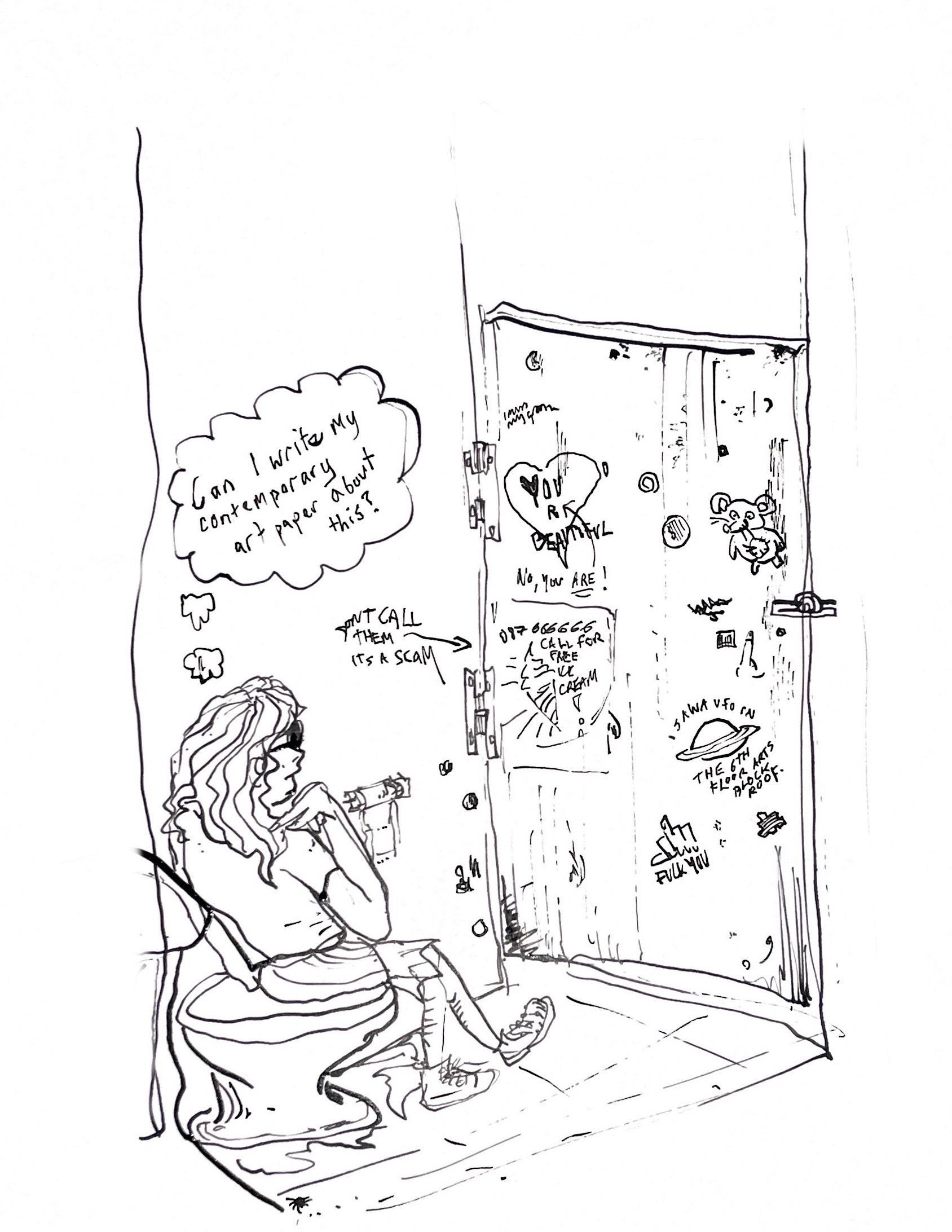
The pleasure of joining a queue that curves out the door, standing between tourist and classmate, is one familiar to the common victim of the Arts Block women’s bathrooms. There are only so many ‘ten minute’ breaks one can spend queuing for half an hour before realising it is quicker to climb a few sets of stairs to the stalls of the upper floors – a higher ground that promises fewer Americans gushing over a life affirming ten second glance at the Book of Kells. Besides the lack of tourists, however, the true highlight of these student-only lavatories is the literature that accompanies one’s visit. Between societies’ shameless self-promoting stickers, half-torn play posters and a couple dozen QR codes begging you to take part in a research project, what little free space remains on these walls is filled with the wisdom of arts students long-departed, scribbled and scratched into the chipping paint.
Women’s bathrooms are a sacred space in and of themselves. Taking a step away from a frantic night out, one can always rely on those they will meet in front of the mirrors to back them up, to agree he is treating you awfully and you should totally leave him, or that she’s your best friend and you’ll make up, it’s all going to be okay. They will remind you how fab you look, will tell you if your makeup needs fixing and gladly do this fixing for you. Something about the space permits a blurring of the boundaries set by our usual social conventions, allowing for this characteristic camaraderie to blossom in their place. Nowhere else is it so natural to weigh in on the next big life decision of a total stranger, or simply to compliment their outfit.
In secondary school, the aura of the girls’ bathrooms allowed the veil of social politics and teen awkwardness to temporarily slip. As the only acceptable place in school to have a good cry, it was never uncommon for whichever girl happened to find (or hear) you first to intervene with whatever advice, comfort, or tissues she had. When I first entered Trinity, I was genuinely troubled by the loss of my tried-and-tested secondary school cry spot. The four walls of those girls’ bathroom cubicles reeked of teen angst and hormone-infused melodrama, but they were a reliable comfort. I was crushed upon the realisation that not only would my tears have a queuing audience, but that I’d have to wait between the tourists to get to them. Thankfully, that spirit of this universal, boundary-blurring space is not localised to any one bathroom and, in the case of the Arts Block, was just a set of stairs away.
Apart from the endearing characters, an integral promise of the women’s bathroom is the reading material it provides. The Arts Block is no exception. We have all skimmed this genre of stall writing carved, scribbled, or printed in all caps on the walls around us. Before our beloved Trinder, Tringe, and Trossip Girl, there were the Arts Block’s bathroom walls. Trying to explain my concept for this article to friends, I was met with some confused looks. What I wasn’t expecting to find was a whole field of academia dedicated to this niche obsession. Sociolinguistic studies of the writings and imagery we leave in bathroom stalls have coined an academic term for this phenomenon: Latrinalia. And to any amateur researcher interested in the field, let me tell you, the Arts Block is a linguistic treasure trove. Inscribed on these walls is the collective philosophy of all who have passed through them. These words feel like a mix between a motivational Pinterest board and a secret vent account, yet predate the intangibility of such internet posting. Accompanying Latrinalia is the comforting knowledge that those who wrote these messages were once exactly where you are, both in location and in life.
The gospel according to the college bathroom walls contains a plethora of worthwhile advice: “Do not date a BESS man”, one writer warns. On the theme of love, couples’ initials can be found encased within arrow-struck hearts, as if on an ancient tree. However, contrary to the reports of a recent Piranha gag, the majority of Trinity’s latrinalia more than passes the Bechdel test. Most of the inscriptions are motivational in nature, left from one visitor for another. Occupants are reminded that “You deserve better than having to beg for kindness”, implored to “Listen to screentime notifs, you’re worth more than the media you consume”, and reassured that “Bad things all pass, or you learn to live with them. Hang in there”. The bathroom stall is an escape, a space to drop one’s mask of composure for just a moment in the fast-paced world of college life. While the sentiments of such latrinalia may feel trite, these messages can find their right audience in the right space.This feeling is summarised by one of the writers themselves, stating “I really needed to read these today – thank you women”.
What is particularly interesting about toilet stall graffiti is its departure from the art form’s conventions. These micro-acts of deviant behaviour, permitted by the privacy bathrooms require, are unlike the flashy displays of classic tagging. In most cases, latrinalia is anonymous, without a name or pseudonym to attribute it to. It leaves only a message. While it is a natural desire to state “I was here”, such art says “I was here, so let me tell you”. What is entered into through this art, while remaining fully anonymous, is a constant and enduring conversation between the women of the college. This is not only a conversation in the conceptual sense. In the Arts Block stalls, back and forth discussions are documented and old ones painted over. New readers add to the sharpied dialogue in their own scratchy ball-point pen. In many cases, like the Ship of Theseus, replies remain long after the original message has been chipped away. These conversations mimic the brief, impactful and mystifying discussions between strangers that take place aloud in these same spaces, fossilised on the walls for future days.
“I’ve learned more from toilet walls than I’ve learned from these words of yours”. This mocking phrase dominates the bridge of indie-rock band Los Campesinos’ 2010 track ‘We’ve Got Your Back’. Clearly intended as a dig at the literary quality of bathroom stall graffiti, I can’t help but wonder if this sentiment would have been different were lead singer Gareth Paisey a girl in her twenties. From my observations, besides written words, the most common mark left on the Arts Block women’s bathroom walls is a heart. This, I believe, encapsulates the motivation behind the majority of this space’s Latrinalia – among the seemingly arbitrary scribbles, a continual concern for the welfare of others is expressed. Whether one has come to seek or provide comfort, to scream into the void or reply to such shouts, this community noticeboard offers its space to us all. In an anonymous, everlasting conversation, the women of Trinity say to each other:
“You’re gonna be okay”
“You are loved, I promise”
“Have a lovely day, beautiful”

Leave a Reply