
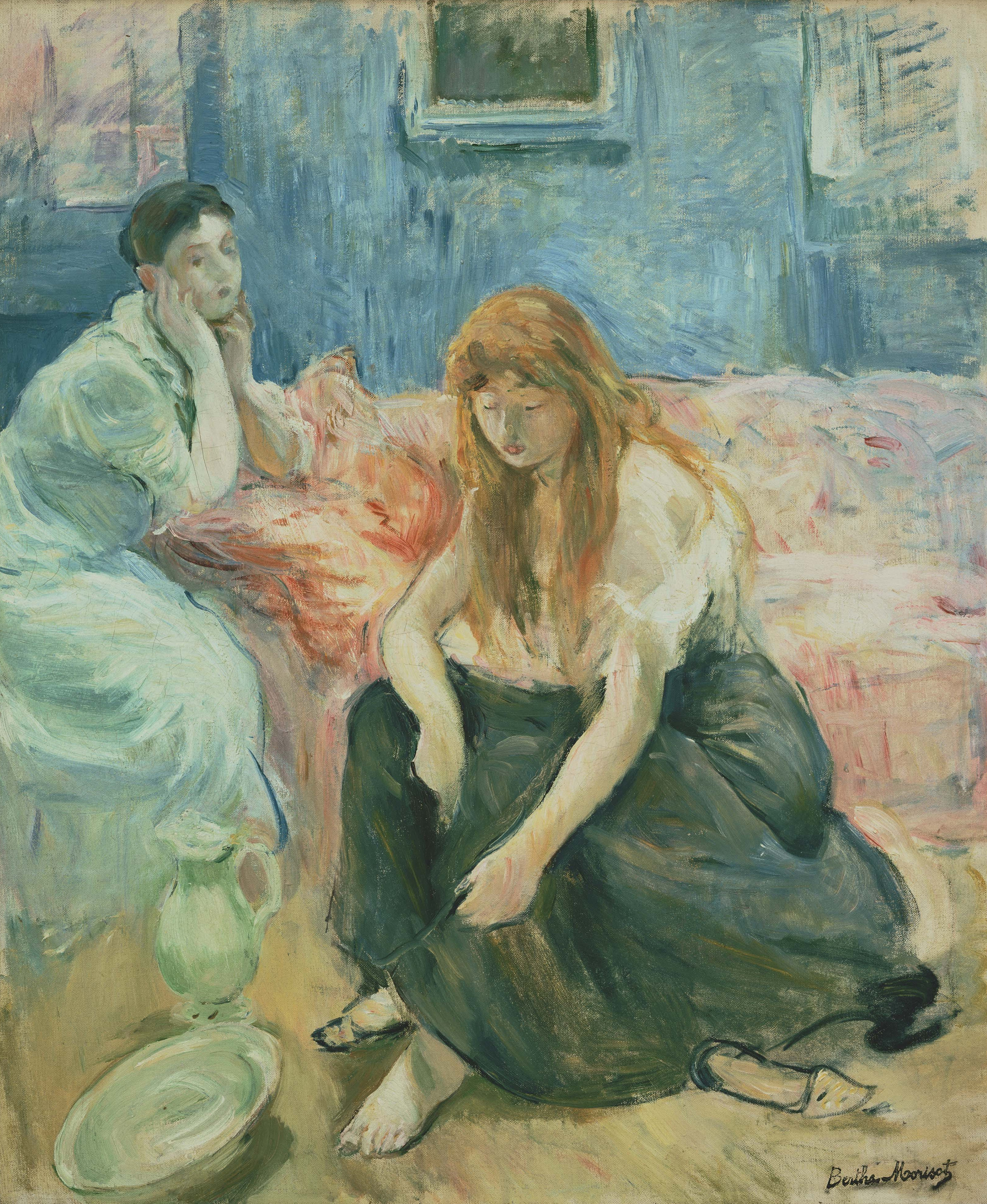
Tucked around the corner from Trinity’s campus, overlooking the greenery of Merrion Square, the National Gallery of Ireland stands guard, beckoning visitors with its striking white facade. With the beautiful collection of pieces and its proximity to campus, Trinity College students can often be found pursuing the exhibitions and scouring the Gift Shop for another postcard to add to their walls, or tote bag for their collection. Both Trinity and the National Gallery are major contributors to Dublin’s cultural landscape and, in a somewhat serendipitous turn, both have recently been attempting to recognise the work of women artists. The renaming of the Eavan Boland library coincided with the conclusion of the National Gallery’s ‘Women Impressionists’ exhibition, organised by modern art curator Janet McLean, a former Trinity student. Misc spoke with McLean in October to discuss the curation of women’s art and its growing popularity.
As a modern art curator, McLean’s major focus lies within art produced from the 19th to the 20th centuries. During this time, the Western world underwent major political, social and economic shifts that were in turn reflected in the artistic sphere. From Impressionism to Expressionism, Cubism to Surrealism, modern art was ever-changing and ever-growing; for the female artists of this explosive period, their position within the artistic community was also continuously shifting. Of course, the situation for modern female artists depended on the specific period, place and culture within which they practised. For women within the Impressionist sphere, McLean pointed out that “many of them were studying at that time and had undergone some sort of artistic training”, a luxury that women of lower classes and positions were not afforded. However, certain restrictions still inhibited many of these female artists from fully exercising their skill or profiting from their art. Marriage, for example, usually put an end to their artistic careers as the demands of family life prevented them from continuing work after they had a husband and children. Much like Virginia Woolf would highlight in her seminal text ‘A Room of One’s Own’ in 1929, “A woman must have money and a room of her own if she is to write,” McLean noted that these female Impressionists “needed the head space and physical space to work” – two things that marriage rarely afforded. Reduced to the world of the domestic, it was also deemed inappropriate for married women to exhibit and sell their art during this period. However, certain women forged spaces for themselves amidst the confines of marriage, such as Berthe Morisot. Married to the younger brother of Édouard Manet, Morisot was able to practise her art and showcase her work in exhibitions with the support of her husband. He not only consented to her profession, but actively encouraged her success and devoted much of his time to supporting her work.
Restrictions upon women artists from the 1920s and onwards were not as overt or potent. Though marriage no longer translated to an almost certain conclusion of their careers, gendered social conventions continued to persist and affect the lives and art of women. Art historians and curators, as well as enjoyers, must consider the varied positions that women of the modern art period held from a curative perspective; how did their position affect their art, and should this information be detailed within an exhibition?
Art curation, in the broadest sense, can be boiled down to two major components: the acquisition of art and its subsequent exhibition. Relative to their speciality, curators bear the responsibility of sourcing, purchasing, researching and displaying art pieces to the public. Theoretically, this process remains unchanged regardless of an artist’s gender, but McLean has found that certain aspects of curation greatly differ for women’s art. When she began her career with the National Gallery, she found that art by women was generally easier to acquire than it is today: “People have begun reassessing women’s careers and buying more of their art, meaning there is more available on the market but its popularity makes it more difficult to acquire.” As the public’s interest in women’s art continues to increase, curators must find different avenues to access and exhibit women’s art. McLean gave the example of Hannah Höch, whose vibrant painting ‘Duft’ she recently acquired for the Gallery. Best known for her visionary photomontages, Höch’s paintings are comparatively less sought after and usually sell for lower prices. This provided McLean with an alternative route to accessing Höch’s work, opening up a less familiar area of her artistic output for the public to admire and appreciate. By seeking out other elements of women’s creative productions, curators can continue to source and display women’s art, navigating the difficulties that its relatively new popularity has presented.
Rifling through the Gallery’s Gift Shop after visiting the Women Impressionists Exhibition, I bumped into my friend and her mother. After initially voicing her disappointment that my friend had falsely advertised the exhibition as Women Expressionists, not Impressionists, my friend’s mother conceded that she had noted the abundance of women’s art within the Gallery, something she found lacking in many other galleries. McLean similarly recognised the Gallery’s dedication to curating art by women; “The National Gallery has been acquiring women’s art for years… as curators, we don’t have resistance from our directors as long as the art is good.” As an institution, the curation of women’s art and its prevalence within exhibitions is facilitated both by the work of the Gallery’s curators and the system that they operate within.
It is one thing to acquire art, but its exhibition and presentation is also a major part of the work of a curator. In the construction of visual narratives, choices are made concerning the placement of pieces to create a story for visitors, and the small inscriptions that accompany works must encapsulate the essence of the art whilst illuminating a portion of its history. In the exhibition of women’s art, there is usually a recognition of the particularly gendered obstacles faced by the artists, whilst simultaneously setting them within the wider context of their artistic circles. When speaking about this, McLean emphasised the importance of “finding a balance” between these two elements of women’s stories. An exhibition must acknowledge the difficulties that women artists have tackled, but it should not completely divide them from the support they received, particularly when dealing with artists of the modern age.
In general, avant-garde spaces were much more receptive to women and valued their work, “the Impressionist men were hugely supportive of women and they all took inspiration from each other.” While it is easy to fall into a black-and-white tale of gender opposition and derision, it is rarely an accurate portrayal of the reality faced by these women artists – many of them did receive support from male counterparts and held the position of an artistic equal within these circles. Curators bear the responsibility of portraying the nuances of these relationships and struggles, striking a balance between the acknowledgement of patriarchal oppression whilst celebrating the support that women received for their work.
The 19th to 20th-century art spheres were incredibly rich, coloured by an abundance of artistic movements and contemporary influences that often reflected the turbulent political and social developments unfolding throughout this period. The life of one artist could bear witness to the rise and fall of multiple movements, each of which may have shaped the style and imagination of those living through it. McLean highlighted the importance of acknowledging the breadth of these influences whilst situating them within a specific moment; “We are very conscious of placing artists in the context of the social world, art world, and their own personal lives … It is important to anchor them in a context in order to give them justice.”
As she showed me around the gallery, McLean pointed out a painting by Alice Neel, a much-renowned portraitist of the 20th century. This particular painting depicts a snowy New York, rooftops drenched in a white that starkly contrasts the grey and red hues of the buildings. It was painted in a hotel room, where Neel had fled after her partner had destroyed most of her work in a burst of anger. “This painting marked a new beginning for Neel,” the inscription states. For McLean, the specific personal context of this painting, as well as Neel’s notable departure from her usual portraits, are integral to the appreciation of this piece. Women’s art in particular benefits from contextualisation; as the social and political status of women changed rapidly in the 20th century, art was often a tool for exploring these shifts, as well as a more personal means of self-expression.
Strolling around a gallery, moving from room to room, we are mere victims to the curators’ choices – where they have placed the art, and chosen which pieces to hang side by side determines where our gaze is led. An exhibition must be physically composed to reflect certain messages or stories that the curator wishes to convey. When handling women’s art, curators must address a major question; should their work be explicitly divided from the work of men? For McLean, finding a balance between celebrating the work of women and allowing them to exist alongside their male contemporaries is integral to adequately appreciating and exhibiting the work of these women. I would have to agree with her. The separation of art on a gender basis is useful in many ways, such as to provide a space for female artists who may not have been showcased otherwise, and attracts audiences particularly interested in women’s art. However, if this is taken to an extreme, I fear that we might lose an appreciation for the genius of the art itself, blinded by the context of its artist’s gender. It raises the question: is women’s art not worthy of hanging alongside other works in and of itself? The Tate Britain has just concluded an exhibition titled, ‘Now You See Us: Women Artists in Britain 1520–1920’ which celebrated the work of British female artists across a period of 400 years. Whilst the showcasing of women’s art should be encouraged, I do wonder if there is something amiss by grouping a whole bunch of women artists together, from very different periods and backgrounds, as the Tate has done, simply for the fact that they are women. Have we not yet moved past this naive form of representation? Are women artists not worthy of more nuance?
Personally, I think that this issue can only be avoided by incorporating women’s art into a wider narrative, as well as a gendered one. As McLean noted, at the National Gallery, they “try to integrate the pieces into a wider space and we believe that they stand out on their own.” By creating specific exhibitions such as ‘Women Impressionists’, which combine gender and artistic contexts, while also integrating women’s art into permanent collections, curators can simultaneously acknowledge the struggles of women artists whilst demonstrating their value parallel to the work of men.
While we were discussing the changing attitudes surrounding women artists, the topic of Trinity’s recently renamed Eavan Boland library came up. As the first building on Trinity Campus to be named after a woman, it marks a significant turning point in the recognition of women in academia, sparking wider conversations about what progress can continue to be made to champion the achievements of women. McLean recalled her own time in Trinity, where Art History was still dominated by an exclusively male canon: “When I studied Art History in Trinity, I can’t remember studying any women artists … we did look at how women were depicted in pictures but this art wasn’t by women.” Whilst this was symptomatic of a wider attitude that diminished or undervalued the work of women, McLean noted that this issue was not just institutional, but rather a systematic failure to acknowledge female art. “The information wasn’t there or as available as it is now. It was a bigger issue than Trinity.” As more research has been carried out to uncover the lives, stories, and works of women artists, academics and the public alike have finally been afforded more opportunities to regard and appreciate women’s art. The availability of information concerning these works has been made even more accessible via digitalisation – the internet has undoubtedly contributed to the popularity of women’s work that we see today.
The demand for women’s art is only growing. Curators such as McLean have the tools to allow women’s art to no longer merely persist against a male-dominated canon, but to let it flourish. The National Gallery of Ireland, and its dedicated curators, bear the responsibility of giving justice to women’s work and affording their lives the nuance it deserves.

Leave a Reply