
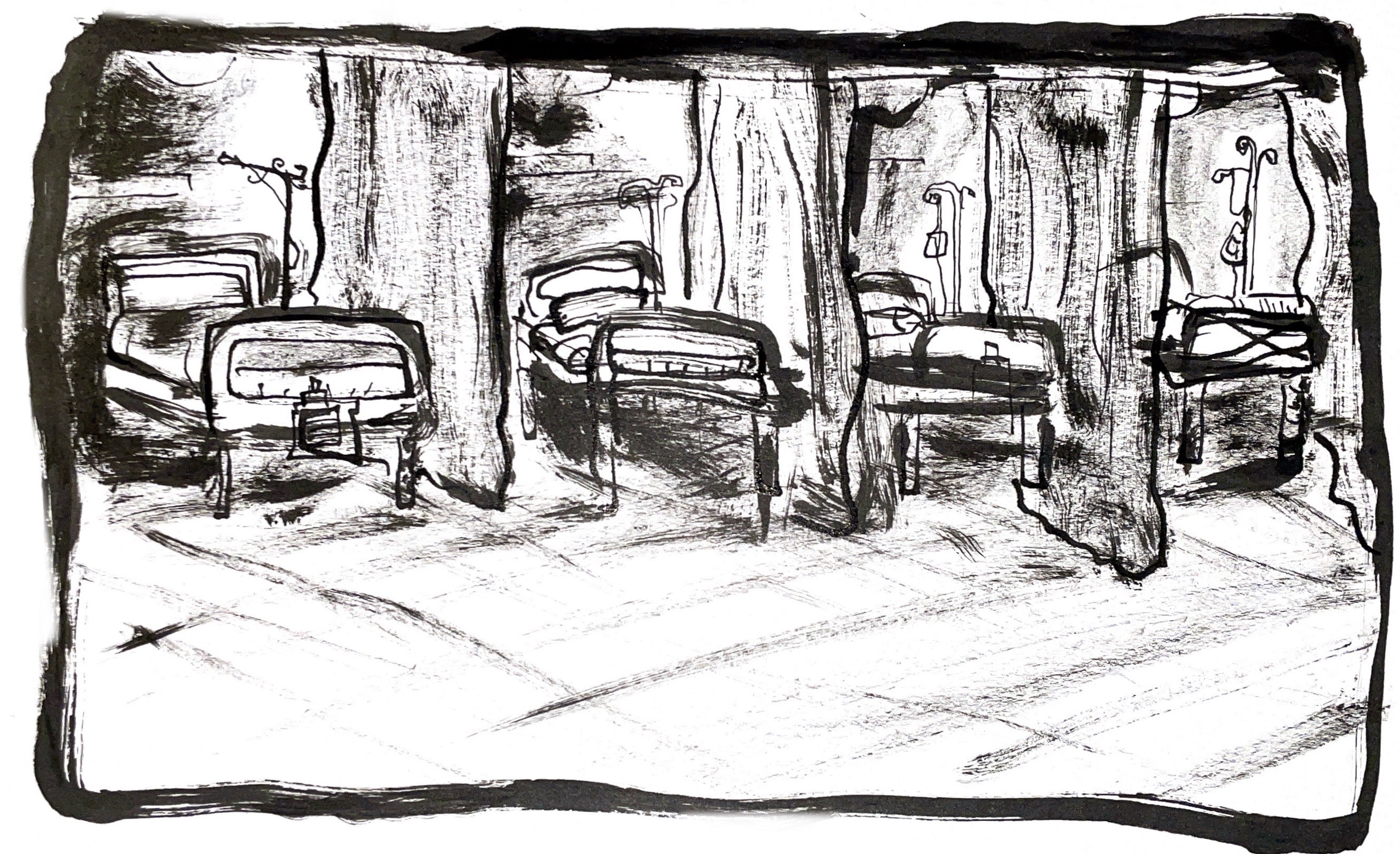
A fictional account of a day on shift as a medical student.
I am used to being the annoying medical student at this point, in fact I’m an expert in the field. I’ve become skilled at finding the most inconvenient place to stand in, at dropping everything I’m told to hold and not knowing the answers to the simplest questions. As I start my last rotation of the year I feel I have become seasoned. In fact I have compiled, through much research, tips for preparing for your role in the MDT as a pestering medical student.
- “Med student” is your new name. Accept it.
- Never bend over. Your pockets will empty like Mary Poppins bag scattering to every corner of the ward and drawing second-hand embarrassment from everyone.
- Tell every specialty that this is your dream one, this makes life a lot easier.
- If you don’t have a caffeine addiction already, sorry but you will by the end of the year, at least the doctors will probably pay.
- There are a thousand acronyms – learn them. You don’t want to ask why a stroke patient needs SALT.
No amount of experience though makes the first day easy. There’s usually another student so we can trauma bond together, half price on therapy, etc but I cannot spot them. I am especially apprehensive about this placement though as it’s in orthopaedics surgery and I only found out on the Luas this morning that break=fracture. Maybe leaving the learning to the cramped, overstimulating Luas when my eyes were still adjusting to the morning was not the best idea. I finally force myself to approach the office. There is a long awkwardness as I try to decide whether to knock or just wait. The hallway to the door is a dark void and deafeningly silent with no sign of life on the other side, it isn’t exactly welcoming. No choice now but to enter the lion’s den. With a shaky breath, I knock.
I stifle a laugh as I enter the room—it’s just as the stereotype predicted. All the men are over 6 feet tall, discussing a weekend football game, with gym bags strewn beneath the tables, creating a hygiene hazard. I half-expect a tub of protein powder in the corner. They glance up, sizing me up like potential prey; med students are at the bottom of the food chain. My sympathetic system kicks in—fingers fidgeting, skin sweating, heart hammering.
Recalling nature documentaries, I smile cautiously without showing my teeth, avoid eye contact, and don’t turn my back. They can smell that I’m not interested in surgery. I start scanning for an intern; they offer a safe shelter for us med students.
Interns are invaluable. Medical students follow them like ducklings, lost without their guidance. Interns know just how little we know. On this orthopaedic team, there are two interns. One instantly eases my nerves and takes me under his wing. He’s laid-back yet exceptionally competent, exuding confidence without arrogance. His skill with both patients and the team becomes clear as he seamlessly manages tasks: answering senior doctors’ questions on bloodwork, updating a patient’s chart, bleeping a PT, and explaining the WELLS score to me—all at once. If this is what’s expected of me in two years, I may be out of my depth. As he patiently waits for me to recall something I studied just last night, and have since forgotten, I glance down and notice his mismatched socks, which is oddly reassuring.
The other intern, meanwhile, is less inspiring. At one point, he requested a CTPA for a patient—whose name he couldn’t recall. Perhaps the HPAT should be a bit tougher.
They send me off on the usual job when they want rid of us- to take histories, and I can’t blame them. I can’t imagine being responsible for patients’ lives while having a medical student asking what a blood thinner does. As I leave, I notice two protein powder tubs on a shelf.
The only people we annoy more than interns are patients. In a hospital full of beds, their 2.5 corners become their world, where they receive good news, bad news, and endure the presence of med students. They share intimate conversations while another patient in the room yells answers to The Chase. Remarkably, no patient has ever refused to share their history with me, reflecting their generosity in giving not just their time but also their personal stories.
When I peek around the patient’s curtain, confusion is evident. It’s as if saying “I’m a medical student” translates to “What is the speed of light?” He, as usual, responds with, “Oh, so you’re insert any healthcare job except doctor?” I clarify, “Nope, I’m in medicine,” hoping he just can’t hear me.
“What do you hope to be?” he asks again. I reply, “I’m going to be a doctor one day,” speaking slowly, perhaps patronisingly. It surprises me that he’s more shocked by the prospect of a female doctor than by the fact we’re replacing his hip and sending him home in two days.
Another student arrives, bewildered, stumbling over simple questions even after eight months in this profession of ‘med student’. When the patient tells him he’s a widow, he simply responds, “Cool.” As we leave, the patient calls out to him, “Doctor, when will I be discharged?”—a betrayal to me.
There is a moment after the painful history taking where you have to do the more painful presenting back. I thought I was getting good at them till the last doctor compared mine to a Jackson Pollock painting. It’s all for the holy grail of a doctor’s signature on the precious logbook. The other student accompanies for what I presume is emotional support. Instead, he informs the intern I took 30 minutes with the history. Wow, I hope he didn’t strain his arm when he threw me under the bus. I defend myself, saying patients are generous with their time and personal stories, so if they want to brag about their new granddaughter, I’ll gladly listen. I present the history at the nurses’ station which is like the sun that everything in a ward gravitates around, might as well put on the intercom, and ask everyone to judge. I butcher every medical term with more than two syllables. The intern then takes on the role of Chris Tarrant and starts asking me questions, except this time I have no choices and apparently no phone a friend. I answer all his questions then he asks the big one- what are the genes for Lynch syndrome? Shocked, I manage to rattle off the three genes, trying not to look too thrilled. To my disappointment, he gets bleeped for an emergency and the round of applause is postponed.
Later, I am cornered by a non-intern doctor interpreting an x-ray. When you’ve disappointed the doctors enough, they start lobbying “easy” questions your way, they try to throw you a bone. Once, a registrar asked where I’m from; when I said Belfast, he replied, “No, you’re not,”—a nice confidence boost. The consultant asks me if I’m dating anyone, maybe she’s (yes she!) has been recruited by my mother? Next, she’s going to ask if I’m eating enough meat. She then starts asking if I’m part of any societies and the usual casual chitchat. She shares funny stories from her college days that I don’t even have to force myself to laugh to. I have yet to work out what part of the body I’m staring at, never mind where the fracture is, but I suddenly feel comfortable enough to admit my incompetence. She starts to teach me how to interpret any x-ray. I now have an advantage over the other medical student- not that I’m competitive.
A morning of catheter insertions and painful PR exams has left me ravenous. I manage to avoid the team buying me anything – once an intern bought me a sandwich and the guilt still keeps me up at night. I join the other students so we can trauma dump. Sitting down with the other students to debrief, I admit my morning has been mellow. One shares how her consultant called the “feminisation of medicine” the death of healthcare—lovely. Then, another mentions a healthcare worker took their life this week. The air chills, it is a stark reminder of the weight and inescapability of this career and its responsibilities, which can sometimes feel too much.
In the hallway I notice a patient wandering and start chatting while the interns hide from me, they must have ditched the trackers I put on them. The patient recognises me from the ward round earlier in the morning when we startled her awake at 7am and demanded to know if she had used the toilet recently, I’m usually hidden at the back doing contortions to see in between everyone. She said she had noticed my “pretty” hair, I’ll make sure the doctors prescribe her the good drugs (joking). It is refreshing to talk to a patient normally and not ask if she ever used drugs or what her c-section was like. She shares her fear of losing mobility and missing out on running after her grandkids, even showing me their photos. A reminder that each patient has a story beyond their history. She may forget me, except for my amazing hair of course, but I’ll remember her now.
Later, I learn that a patient I took a history from earlier in the day has deteriorated. The impact is profound; the idea they might not make it to tomorrow feels unreal, I hope I never get used to this feeling. The team springs into action, they don’t have time to dwell, they are the ones who have to determine the next steps. It is a potent reminder that I’m not just playing dress-up. As I’m processing this reality, my pen explodes, ink covering my hands as I stumble into a bin that crashes loudly, spilling everywhere, and commanding everyone’s attention. Typical.
The good intern might be ready for a restraining order on me—no good deed goes unpunished. He encourages all my questions, however basic (I asked him what to give someone with low potassium, the answer was unsurprisingly potassium), and lets me take on real responsibility, making me feel part of the team. He has me read ABGs so often they feel like ABCs now. The other intern isn’t as keen on teaching; when I was relegated to him at one point and I pointed out that a patient on DAPT should probably also be on a PPI (I do know some things), he casually dismissed it. I checked with the other intern, who confirmed I was right and called him over. Oops, I told Mum on him. He just shrugged; he doesn’t carry the weight of representing his entire gender every time he makes a mistake—oh, to be a man.
The end of the day arrives. It actually comes very fast. I propose the prospect of leaving and they inform me I could have left whenever. Thanks for letting me know. Truthfully, I would have stayed due to the amazing opportunities. There was the SHO who listened to my history while eating his lunch, the stoma nurse who detailed the psychological effects of stomas, the registrar who wouldn’t let me leave till I could distinguish chest sounds, the nursing student who taught me how to apply ECG leads, the CNM who high-fived me after every cannula as he knew I was nervous. If I become a good doctor one day it is because of them and I am grateful.
At the nurses’ station, in the chaotic calm, you can see the real healthcare system. Everyone working together, united by the common bond of wanting one simple thing- to help people. Although there’s faults, I know this is where I want to be. There’s a lot more good than bad, and hopefully the bad moves to Australia.

Leave a Reply