
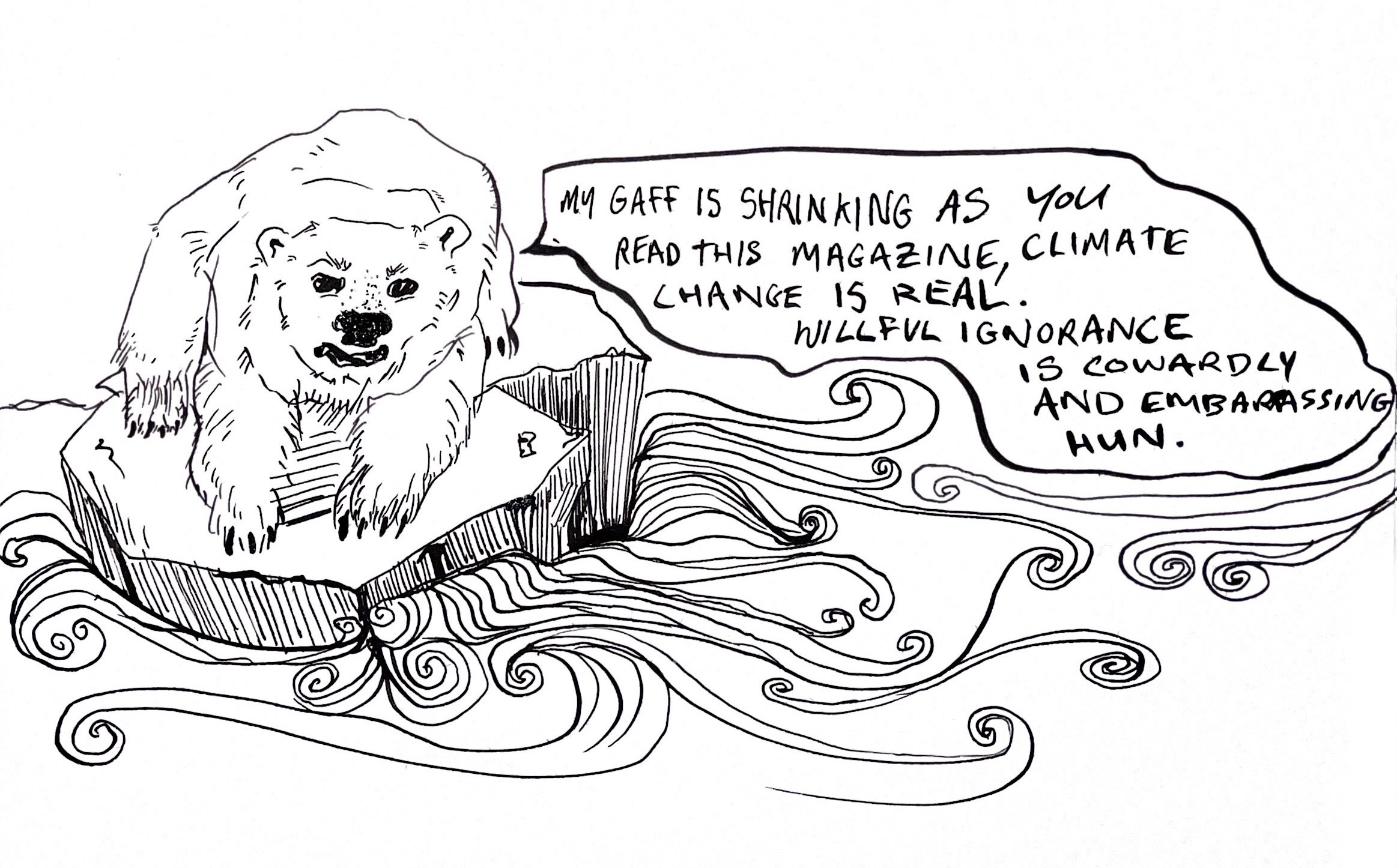
It is common knowledge, I think, that one will experience culture shocks when studying in a different country, some more expected than others. I had the opportunity to study in Tromsø, Norway last semester, and was shocked plenty- bus drivers went unthanked, cuisine was more dried fish-heavy than I care for, and my Finnish roommate of 6 months left with no goodbye (and all of our shared toilet paper). But, perhaps most shocking of all to me was the way in which Norwegians taught and talked about their famed petroleum industry and particularly its relationship to climate change.
It is no great kept secret that the burning of petroleum contributes massively to global warming, not to mention the catastrophic impacts offshore harvesting can have on local wildlife. Indeed, the burning of fossil fuels (including coal and natural gas) is responsible for nearly 90% of global carbon dioxide emissions, in turn leading to the continued overall heating of our planet, resulting in massive knock-on effects across the globe, seen currently in the forest fires ravishing Los Angeles.
The understanding at the very least that we-should-limit-our-petroleum-use-because-it-is- bad-for-the-environment is one that has been spread amongst our generation in every facet of our lives. This is largely because of concerted efforts made by our governments to preach this idea as much as possible through initiatives such as Green Week. The Global Citizenship Education Initiative aims to spread climate literacy in Irish common education, and in Trinity, a mandatory sustainability module is being created, following in the footsteps of Stanford, Berkeley and Columbia in the United States. In Geoscience specifically, every module I have taken across my two years at Trinity has touched on climate change in some sense, to the point where to explain climate change in such an article feels as pointless as explaining that the Earth is round. It is a truth as unavoidable as birth, death and taxes.
Because of this, I found myself baffled by my experience of Norway’s relationship with petroleum. Tromsø is a small island city, located in the far north of Norway within the Arctic Circle, and is close to many significant oil and gas fields. Presumably because of this, and Norway’s extensive history in the petroleum industry, most of the classes offered to me at the Arctic University of Tromsø (UiT) were related to petrology to some extent or other, with ‘Petroleum Geology’, ‘Management of Petroleum Resources’, and ‘Petroleum Processing’ all mandatory subjects for Geoscience students at UiT. Trinity’s Geoscience options by comparison tend to be more focused on the volcanic side of Geology, in line with the mineral makeup of our land, but also include mandatory modules such as ‘Earth’s Climate – Past, Present and Future’, which focuses on our changing environment, a topic which was noticeable by its absence from my experience studying in UiT.
You see, Norwegian citizens have a vested interest in the continued harvesting of petroleum. Since 1990, the people of Norway have benefited from the Government Pension Fund, or the ‘Oljefondet‘, which makes it so that surplus wealth generated from government-owned oil companies, such as Equinor is deposited into a fund for future generations, to maintain Norway’s wealth after their offshore oil deposits are exhausted in an estimated 50 years. Furthermore, graduates in geoscience are ranked among the most employable in the country. This meant that most students and professors I interacted with in my time studying in Norway stood to benefit in the continued success of Norway’s offshore drilling. I found all of my Geoscience modules to be lacking in any sort of awareness of the social or climatic impact of offshore oil drilling.
Take, for instance, one of the modules I studied in Norway: ‘Integrated Subsurface Geological Analysis’, a module which ‘gives an evaluation of conditions and processes involved in the generation and transformation of organic material in source rocks and the migration of these hydrocarbons to reservoir rocks.’ Included in this module was a trip in an Equinor office in Trondheim, a Norwegian city further south. Here, a baffling presentation was given to us students in which the speaker cited the Paleo-Eocene Thermal Maximum, a period of prehistoric time in which average global temperatures rose rapidly by more than 5 degrees across a very short period of geological time, and the Little Ice Age, a regional cool period in Europe across the Middle Ages, as examples of how our climate has always been changing. However, both of these examples were characterised by huge tectonic events causing volcanic activity and changes in the atmosphere’s chemistry through natural causes. By contrast, the increased acidification of our atmosphere as it fills with greenhouse gases is a result of human activity rather than any sort of organic phenomenon, and has no end in sight without societal change.
The speaker carried on, stating that much of the climate disasters being seen today, such as burst river banks and flooding are the result of poor city planning, and not working alongside the environment, through redirecting rivers and building dams. While true in some cases, the unprecedented hot, cold, rainy or dry spells being recorded across the globe cannot be put down to poor foresight. The point of this speech was to open discussions about the fear mongering surrounding climate change, to conclude that it is unrealistic to expect to cut petroleum use completely tomorrow without causing societal collapse. He was right: too much of our green energy sources such as solar panels and wind turbines still require petroleum-based plastic components to function. The narrative he spun bordering on climate change denial, however, I struggle to resonate with. Even more shocking to me was the near dead-silence on the topic from my peers. The task of arguing against this notion fell to myself and two German boys, the only other international students in the class. It became clear to me then that the way I have been taught about climate change my entire life is not a belief as universally held as I had previously believed.
My final assignment for the subject was to write an essay primarily focussed on discussing the UN’s Sustainable Development Goals (SDGs), several of which are directly related to tackling climate change and providing access to greener energy sources. Some of the recommended readings for this essay included ‘The Oil Book’, by Øystein Sjølie, who writes in defence of the ‘hated Norwegian oil industry,’ and instead counters that ‘Norwegian oil and gas make the world a better place.’ Being that I do not speak Norwegian, I cannot share what Sjølie’s reasoning for this stance is, but according to other lectures from this same class, Norwegian oil is more environmentally friendly than other sources because of its lighter, sweeter quality, akin to some sort of Oil Lord Sommelier making it more buoyant and thus easier to harvest from the depths of our Earth, as well as cleaner-burning.
The final part of this essay was to discuss where and how petroleum fits into the future of energy perspectives. To my mind, and also some of the greatest minds of today working in the UN, if we wish to even make a dent in the UN’s SDGs, we should be working towards a petroleum free future. Certainly Norway is aware of the finite nature of its financial success, as is evident from their Oljefondet savings account. So why then does their university education in geoscience seem to skirt the topic of negative impacts of petroleum, like a borehole in their continental shelf? Why bother bringing up Sustainable Development and the goals of the UN if the recommended readings for the essay in question are inherently biased and angled to defend Norwegian oil from the get go? Other recommended readings for the essay included Equinor’s own energy perspective publication.
I do not wish to suggest that Norway is part of some cult of petroleum romantics, nor to suggest that the Norwegian government is operating a propaganda scheme of manipulation against their own people. Simply put, the echo-chambered ideal I have held and been taught all my life, of pushing towards a greener way of living, and banishing petroleum to the Earth’s core forevermore was shattered rather brutally during my time in Norway. I am not naive, I don’t believe that the use of petroleum can be stopped at the toss of a soup can. It is clear that our whole society since the industrial revolution has been built around this fluid finance. But I do not think it naive either to suggest that romanticising the sweet, light oil of Norway’s continental shelf in an academic setting is anything but bad for our global future prospects.

Leave a Reply