
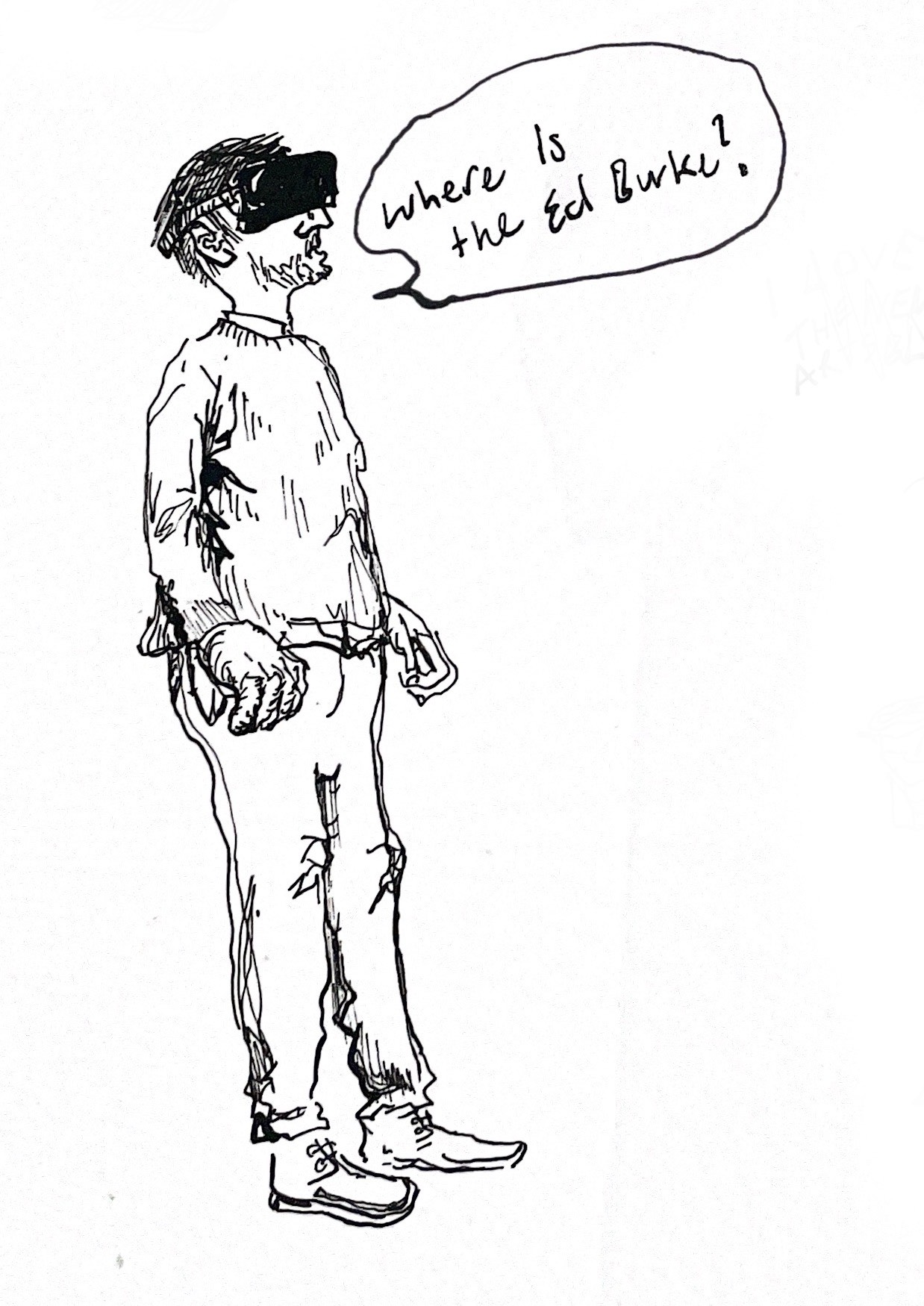
You’re in the Arts Block. The air is heavy and a little stale, distinct scents that cling stubbornly to your clothes. The lights above flicker, not quite enough to notice consciously but enough to unsettle you. You look out the window and realise it’s dark, even though you could swear it was daytime just minutes ago, almost as if someone has flicked a switch. Somewhere in the distance there is a printer grinding, though you can’t place exactly where the noise is coming from. You trace a familiar path along winding corridors, the kind that seem to rearrange themselves, past corners and nooks you swore weren’t there yesterday. Eventually you end up in the Ussher for a half-hearted library session, before somehow ending up in the Pav, then Doyle’s – again.
It all feels eerily familiar. And while of course you have done all this before, there’s still a question worth asking: are your repetitive evenings just a reflection of Dublin’s limited night life and a vicious cycle of deadlines and assignments, or could the patterns hint at something deeper? Are your choices really yours, or are we all trapped in some elaborate computer simulation?
The idea isn’t as ridiculous as it sounds. In 2003, philosopher Nick Bostrom proposed what’s now known as the Simulation Argument. The basic set-up is deceptively simple: imagine human civilisation’s technological developments keep advancing. If our computers get powerful enough, future societies could run ultra-realistic “conscious simulations” or “ancestor simulations” of the past, similar to how archaeologists build model Bronze Age villages to understand our history today. These would be entire simulated worlds, complete with conscious beings who think they’re real.
Then comes the unsettling part. If future societies ever reach the point where they can run one conscious simulation, then they could almost certainly run thousands or millions of them. That means the number of simulated realities would vastly outnumber the single “base reality”. And if there are billions of simulations but only one true original world, then the odds of you being in the base reality rather than one of the copies start to look extremely small.
The argument presents a trilemma: either humanity never survives long enough to build such simulations, future societies deliberately choose not to make them, or the eerie third possibility, that they do exist and we’re already inside one. What Bostrom proposed over twenty years ago as a hypothetical scenario about the future could just as easily be describing our present. If the maths holds up, then statistically speaking, you’re probably already simulated. Put another way, that drunk text you definitely didn’t send wasn’t a mistake, it might have just been a glitch in the code.
Physics doesn’t exactly put the theory to bed either. In quantum mechanics, particles don’t have definite states until they are observed, as though the universe is “rendering” itself only when someone looks. At the very smallest scales, the universe might even have a resolution limit, known as the Planck length, suggesting that reality itself could be pixelated. This is comparable to zooming in on the world until it starts to break down into points of light, like a screen stretched to its lowest resolution.
So when I look across Fellow’s Square during another library session in the Boland, am I really looking at the blades of grass, the performative smokers, the jostling tourists in actuality? Or am I constructing this whole picture from tiny illuminated parts of the whole, the smallest addressable element I can contend with? The cosmic equivalent of pixels glowing in the dark?
A handful of digital physics theorists go even further to suggest that what we call matter is really just information woven into code. Most scientists roll their eyes at the idea, but it does make you wonder: when no one’s rushing to print a lab report, does the Hamilton basement exist – or does it only load when you need it?
Of course, you don’t need to dive into quantum mechanics to suspect the world around you is glitching – think about it long enough and you’ll start to be convinced of it yourself. Tutorial rooms in the Arts Block that seem to relocate overnight. Doors that change from push to pull when you’re in a rush, almost as if the corridor behind it is still loading. Books materialising on a library shelf minutes after you scoured it in vain. The same tourist walking too slow when you’re late to your 9am. Even the daily rhythms feel coded: the same coffee queue forming at the same time, the same one legged seagull threatening to take your food. These little loops make you stop and wonder if we are living our lives freely, or just running through a pre-written script.
There is, of course, what many would call a “rational” explanation, that we’re not experiencing glitches in the matrix but rather that the Arts Block is a classic example of a liminal space. Liminal spaces are environments designed in ways that unsettle us, “in-between” spaces that evoke a sense of unease. Spaces like the Arts Block mess with our perception precisely because they’re so repetitive. This repetition, combined with no windows, fluorescent lighting, questionable ventilation, too much caffeine, and too little sleep means reality itself can begin to feel unstable.
So are we living in a simulation? Maybe the real question isn’t whether reality is coded, but how we interpret the patterns we move through. The sense of déjà vu in the Arts Block corridors, the odd comfort of repeating patterns, the suspicion that reality is thinner at the edges than we like to admit makes us realise that whether it’s code or concrete, our world is stitched together out of familiar loops. But maybe the sense of walking through a world both familiar and strange is part of the charm, as though reality itself is just another building on campus, humming faintly, waiting to be explored.

Leave a Reply