
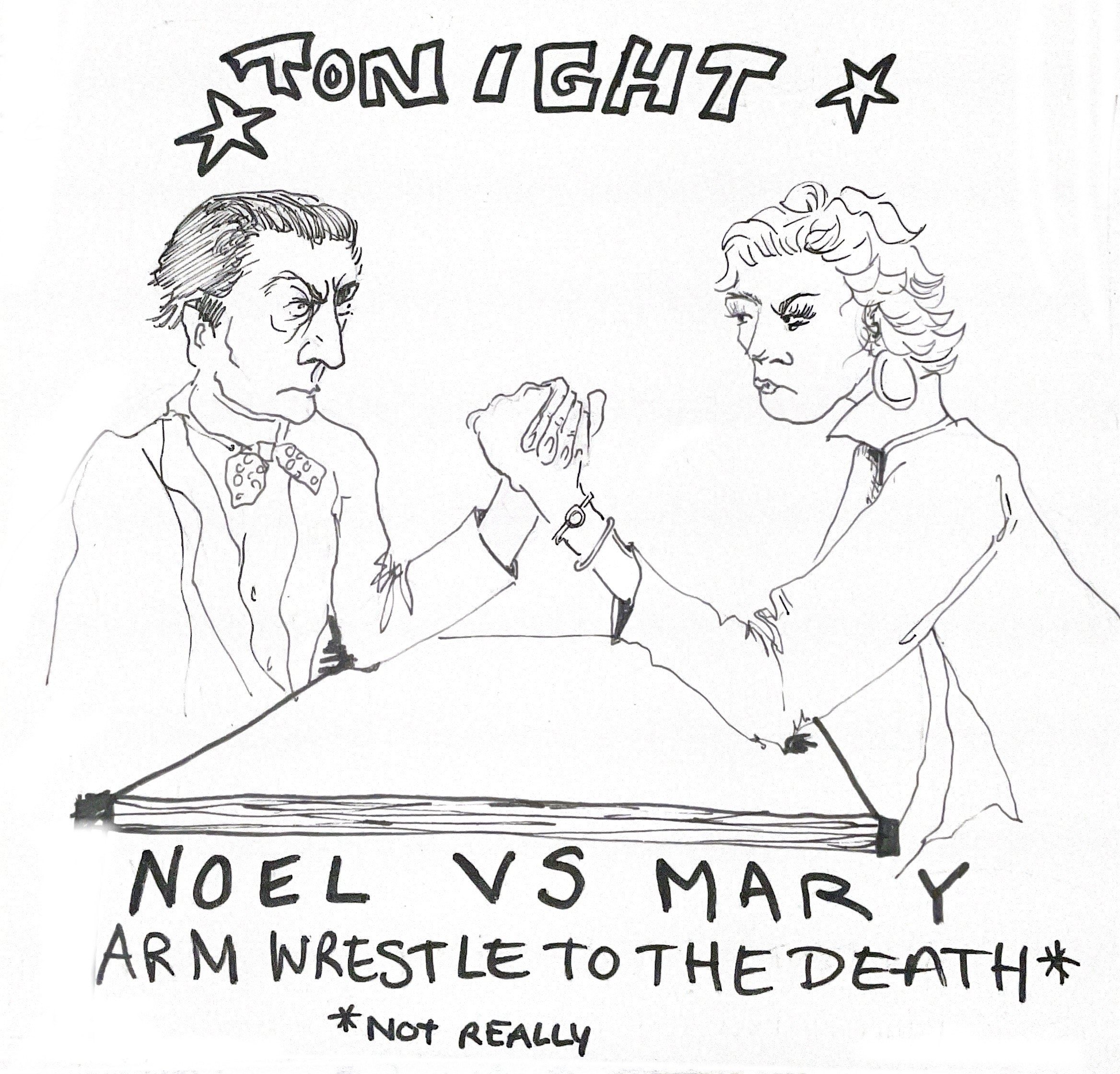
In January 1990, Labour Party Leader Dick Spring announced that his party would run a candidate for that year’s presidential election. What ensued was a nomination process that pitted two of Trinity’s most significant political alumni against one-another. For a brief moment, Ireland’s past and future met, causing success on one side, and resentment on the other. By November, lawyer and senator Mary Robinson would achieve an improbable victory in the presidential election, after a bizarre and seismic campaign. However, this early leg of the campaign (rarely paid any attention by historians) can lend us a very clear understanding of Ireland in the 1990s and the changing place of Trinity College in the Irish public psyche.
Dr Noël Browne is a giant in Irish political history. He is credited, in a 1997 obituary in The Lancet Journal, as ‘the scourge of Irish TB’. Both of his parents and five of his six siblings died of tuberculosis before the young Noël had reached his twenties. In his early thirties, as Minister for Health, Browne began an overhaul of the Irish health system, including initiating efforts to eradicate tuberculosis on the island. Though popular with the public, Browne would be forced to resign after his controversial ‘Mother and Child Scheme’ brought down John A. Costello’s coalition government in 1951. Today, the scheme (which would have provided free healthcare to mothers and children) is considered ahead of its time. Likewise, Browne is remembered fondly as an anomalous man of principle among the god-ridden politicians of mid-century Ireland.
Browne had encountered extreme difficulty in getting to his brief cabinet role, facing scepticism and, sometimes, outright disapproval from the Catholic authorities in Ireland. Browne had attended Trinity, studying medicine. As a Catholic, he defied Archbishop John Charles McQuaid, who had (by proxy of the Vatican) forbidden Catholics from attending the traditionally protestant university. In McQuaid’s words, doing so was a ‘mortal sin’. Browne was therefore tagged as a ‘Trinity Catholic’ during his early career. In his autobiography, Against the Tide, he considers this to have been a significant barrier to employment as a practicing doctor in Ireland before his career in politics, and notes that he was the only Trinity graduate in Costello’s 1948 Cabinet. His undergraduate years in Trinity became a signifier to the political establishment of his unworthiness of public office. After his 1951 resignation, he burned bridges with Fine Gael and Clann na Poblachta and bounced between parties over a decades-long career in the Dáil (including Labour, briefly). Browne’s biographer John Horgan argues that it was this outsider status, bred by his years spent outside the influence of the Catholic hierarchy in Trinity that made him such a brash force in Irish politics, and ultimately made him so naïve to the way Irish politics actually worked.
In 1973, Browne was elected to the Seanad, serving the Dublin University constituency. The only person that finished above him in the poll was a senator running for her second term, Mary Robinson. As colleagues, they tackled taboo social issues. Through the leadership of Robinson and the (indirect and conditional) encouragement of Browne, contraception and family planning became a seriously discussed issue for the first time in the mid 1970s. Both Browne and Robinson supported Senator David Norris’s campaign for gay rights. Norris recalls Browne being ‘laughed at’ by other politicians for bringing Norris’s campaign to attention. Like Browne, Robinson was a Trinity Catholic. In fact, she was the first Catholic elected to a Seanad seat in the Dublin University constituency. Considering their very different paths to political power, and their emergence from very different social circumstances, their convergence on many political matters was remarkable. Nonetheless, their time as colleagues was limited.
———–
Early in the year, Dick Spring got to work finding a candidate that ticked all the boxes for Labour. He wanted someone young, someone who would redefine the presidency, and someone with a dazzling resumé. Mary Robinson fit the bill perfectly. Robinson, however, had left the Labour party over a personal stance she took on Labour’s sponsoring of the 1985 Anglo-Irish Agreement. This was a hurdle, as Labour, of course, wanted an active Labour member to be their candidate. In the meantime, other Labour TDs Emmet Stagg and Michael D. Higgins had come together to push their political precursor Noël Browne towards the nomination. Browne, also a non-party member, was interested. After his disheartening stint in government, it was easy to see a potential presidency as his shot at political redemption, and the public’s apology for not appreciating him in his day.
Soon, Spring and Robinson compromised. She would run as an independent candidate, with endorsements from Labour, the Greens and the Workers’ Party. This semi-independent model candidate would prove successful for the 1990, 1997 and 2011 presidential elections. Browne, helped by some party insiders, won the support of groups like the Worker’s Party and the Labour Women’s National Council. Labour voted in April between Robinson and Browne. Despite Browne’s momentum, Robinson’s endorsement and selection by Dick Spring was enough to carry her to the nomination. Spring rang Browne to inform him of his defeat. It was a very short phone call. Robinson’s biographers Olivia O’Leary and Helen Burke give a slightly different account, claiming instead that Spring had announced Robinson as the party’s nominee prematurely, before being required to backtrack and schedule a vote between Browne and Robinson once the further-left faction of the party protested Spring’s rashness. Michael D. Higgins was Browne’s biggest supporter within the party, and although he backed her during the campaign, Robinson said it was clear that he would have preferred his friend and first choice to have been the nominee.
While campaigning, Robinson’s personality and her association with Trinity made her appear as the formidable, capable, intellectual candidate she was. Robinson’s association with Trinity had been public and proud. At twenty-five, after studying at Harvard, she had been appointed as Professor of Criminal Law in Trinity, in the same year she was first elected to the senate. She, in contrast to Browne, had experienced Trinity as a benefit to her career, but had faced significant political obstacles elsewhere, obstacles that would be overcome during the 1990 presidential election. One can imagine Browne’s bitterness at this, that a Catholic politician’s status as a former Trinity student could be anything but harmful to their career. Browne’s subsequent public bitterness about Robinson, and the way she conducted herself during her presidency, has a certain taste of misogyny that goes beyond the personal sting of defeat. Browne, in letters to friends and relatives, made Robinson out to be frivolous and shallow. In response to Robinson placing a candle in the window of Áras an Uachtaráin, symbolising the welcoming home of the Irish diaspora who had left in droves over the past century and a half, he wrote:
‘May one grieving Irish family, among those bidding farewell and those left behind, tell our roving President her fatuous, low-watt, low-powered ‘cheapest available, warmly welcoming electrical’ candle brought no comfort to our diaspora and could now, permanently, be switched off’.
Robinson’s biographies never mention Browne’s bitter words. When asked if she would have supported Browne’s campaign had things gone differently, she replied: ‘of course’.
Dr Noël Browne died on 22 May 1997. Browne stated that he was glad, in the end, that he hadn’t run for the Presidency, which he called an ‘impotent, titular post’. The only guarantee of his political legacy was that it would be difficult, and that it would always evade clear definition. His later years, and his underwhelming attempt for ‘The Áras’, perfectly captured the Noël Browne conundrum. Browne’s doctor, after he had been taken into hospital, rang Browne’s friend Michael D. Higgins to alert him of his sickness. Higgins’ answering machine had run out of tape, and so never received the message.

Leave a Reply