
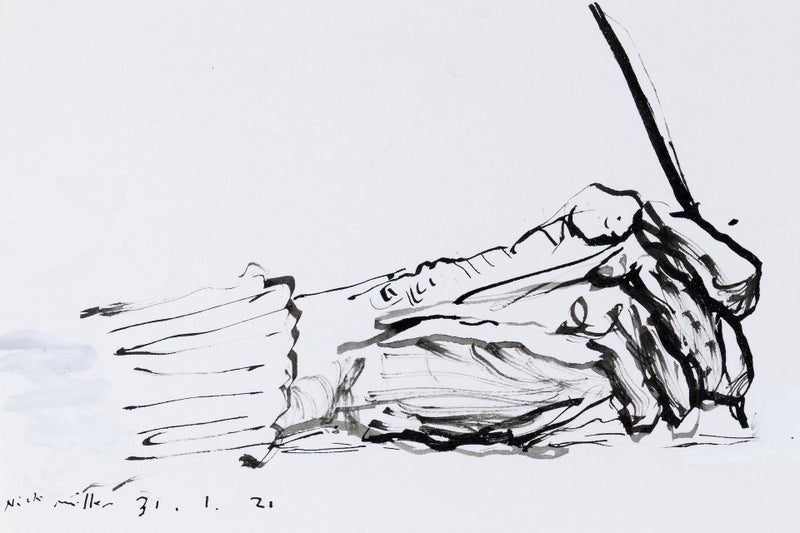
The death of the doodle is an often-unmentioned symptom of the digital age. The notepads that were once awash with marginalia have long since been carried away with the flutter of keyboards and the (alleged) organisation of computer backups.
Yet a scan of the Samuel Beckett Digital Archive gives a sense of how these inscriptions might coalesce with creative process. In many notebooks, Beckett opts only to inscribe the right-side recto page, leaving the left-side verso as a canvas for additions, revisions, insertions, and doodles.
These sprawl from front to back; their flowing lines and cross-hatched shading often indecipherable in form. An annotation of a draft of Waiting for Godot reads: “Doodle 7. Organism, People, Humanoid, Body part, Head, Shape, Circle, Hatching.”
Of particular significance is the title ‘WHOROSCOPE’ scrawled across the front of a notebook in which Beckett composed Murphy, his first published novel. This title repeats that of a 1930 poem that Beckett submitted to a competition sponsored by Paris-based Hours Press.
Whoroscope is a peculiar poem. It tracks the ruminations of Rene Descartes as he awaits the perfect egg. Among its accolades is that its ratio of footnotes to lines exceeds even that of TS Eliot’s The Wasteland. Indeed, Beckett would later concur with detractors and label Whoroscope “un mauvais poème à celui qui comprend que les mauvais poèmes ne sont pas précisément les derniers” [“a bad poem for him who understand that bad poems are not exactly the last.] Nevertheless, the poem won Hours’ first prize, and Beckett took home ten pounds.
This represents the first qualified literary success of a future Nobel laureate and was published two years before Beckett began writing what he would later describe as the ‘immature and unworthy’ Dream of Fair to Middling Women. This was Beckett’s first effort at writing a novel and was rejected en masse by publishers. It is this context which makes Beckett’s reuse of the title on his notebook for Murphy interesting.
Scholars suggest that the notebook was used between 1932 and 1937, meaning that its genesis coincides with Beckett’s disappointment at not being able to get his manuscript published. In one droll entry in the Whoroscope notebook, Beckett writes the heading, “Murphy turned down by:” followed by the names of twelve publishing houses.
Given the sense of failure that came with this, one can understand why Beckett might return to his earlier success as he breaks ground on Murphy and the Joycean pun of WHOROSCOPE does, I argue, compound this view.
The front-end of the pun, ‘whore’, frames Beckett’s writing as an act of prostitution. A sense of writing for money would have been felt acutely by Beckett as he commenced the composition of Murphy. Earlier in 1932, Beckett had resigned from his teaching post at Trinity and by the time he was commencing composition, he found himself unemployed and living in a chambre de bonne atop the Trianon Palace Hôtel in Paris. Thus, the WHOROSCOPE notebook represents Beckett’s first literary act since committing to a life of writing, with its ‘whore’ pun suggesting that Beckett is ‘prostituting’ himself as an artist.
The second half of the title plays on ‘horoscope’. In his mammoth biography, James Knowlson notes that while composing Murphy, Beckett came to learn of psychologist Carl Jung’s insistence that his patients have their horoscopes cast. Knowlson notes that Beckett’s own therapist, W.R. Bion, is reported as having taken an interest in horoscopes and that it is plausible that Beckett had his own cast for this purpose.
Horoscopes make their way into Murphy. When the titular character envisions his new employment as a medical orderly as fulfilling the prophecy of his horoscope, he drops everything on a whim, including leaving his partner. The horoscope becomes ‘no longer a guide to be consulted but a force to be obeyed.’
And perhaps the same could be said of Beckett’s poem. After the failure of his first novel, Whoroscope was perhaps the astrology-esque confirmation that Beckett’s calling was indeed towards the written word. An assurance that, as he would later write, one ought to ‘Try again. Fail again. Fail better.’
In repurposing Whoroscope as a moniker for his process of composition, we see the convergence of two points in Becketts’s sense of self. A commitment to making writing the primary purpose of his life, and a sense of almost religious revelation that it was written in the stars.
So, while doodles may be dead and notebooks no longer in vogue, perhaps in years to come the title of an Icarus poem might reappear atop some Word Document and lead us to a new bestseller. Or maybe the digital age has taken that too.

Leave a Reply