
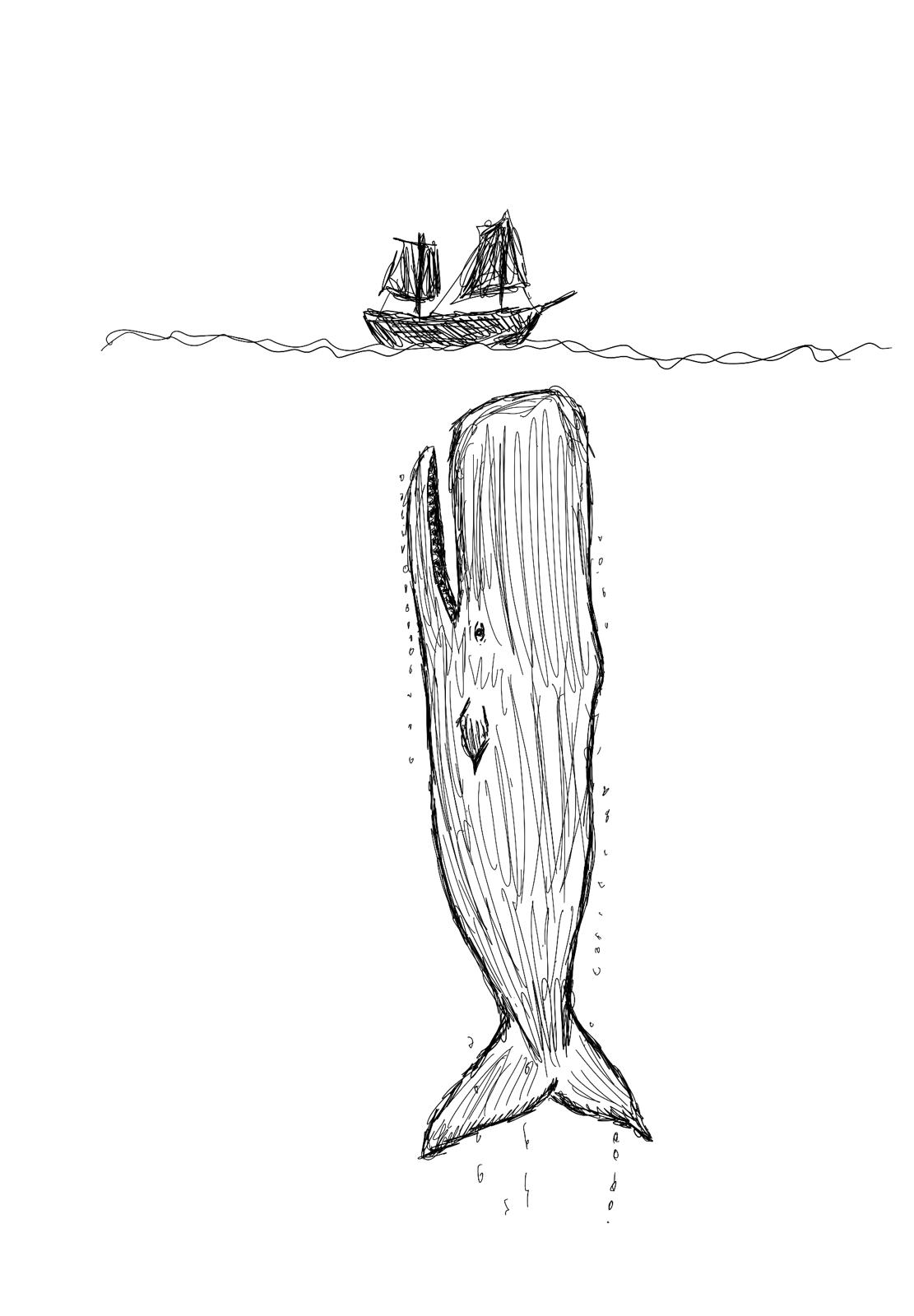
On a particularly fog-covered mid-October afternoon, I made my way to Professor Sam Slote’s office to ask him about his favourite book. I found the office tucked away down a corridor on the fourth floor of the Arts Block and rapped on the door covered with photographs of James Joyce. I put on my proverbial Bloomsday cap and waistcoat and braced myself for a conversation consisting of phrases such as ‘metempsychosis’, ‘agenbite of inwit’ and so on. But alas, Professor Slote is a man who contains many multitudes! My first question, “So, is it Ulysses?” was met with a triumphant “You’d think!” Despite Slote admitting he felt somewhat “contractually obligated” to choose something written by Joyce, he ended up going with the similarly hefty classic by Herman Melville, Moby-Dick, which, like Ulysses, strikes fear into the hearts of many a secondary-school English student. Professor Slote credits Moby-Dick, which he read in the third year of his Philosophy degree, as leading him on to study Finnegan’s Wake and Joyce. If you, dear reader, have not read, Moby-Dick, or the Whale, first published in 1851, I hope this piece inspires you to give it a go. I am sure you will recognise its opening sentence, “Call me Ishmael”, which has cemented itself firmly amongst the literary canons’ most identifiable and iconic sentences, so you’ve already begun without even knowing it! Without further ado, let us discover why exactly this book has secured its spot amongst Professor Slote’s favourites.
Slote describes Moby-Dick as a book that could be “well-written, intellectually deep, emotionally resonant, quite funny and quite scary” all at the same time. Slote explains that he read it alongside Roland Barthes’, The Pleasure of the Text, which argues a distinction between the ‘readerly’ and the ‘writerly’ texts. A ‘readerly’ text evokes a kind of passive pleasure in the reader, while a ‘writerly’ text unlocks an elusive kind of bliss which forces the reader to engage in a more active way with what they are reading. Slote mentions a review of Moby-Dick that came out around the time of its publication which argued that “Mr Melville would have written a fine adventure novel, if it wasn’t for all those weird, boring chapters in between”. Perhaps here enlies Barthes’ distinction, the near-imperceptible gulf between pleasure and bliss lies in “the digressions […] overseeing meaning in each and every thing that’s associated with what would otherwise be a propulsive narrative or an adventure story. But really it’s the depth that happens in and around existence”. It is in these moments that much of the beauty of this novel can be uncovered. For example, Slote cites the image of Ahab nailing the gold doubloon to the ship’s mast as one of his favourite moments in the entire novel; an example of an unexciting act, yet one that is full of symbolic resonance. Other textual intricacies such as the omission of the hyphen in the name ‘Moby Dick’ yet the inclusion of one in the title ‘Moby-Dick’ are yet more pieces to the blissful puzzle of this novel.
When asked what he would say to a student to encourage them to pick up a copy of this 600-or-so page book, Slote argues that it is not so much an issue with this novel in particular, rather we are facing what seems like a global pandemic of attention-span shrinkage. “It’s not even media anymore” says Slote, there are just a greater number of “intrusions on mental life” faced by readers today as opposed to in the mid-19th century. “There are other long books, recent ones as well. It is far from a problem that is unique to Moby-Dick. There is a degree of concentration and intention that may emerge in a lengthy written text.” In a world full of these unabating mental intrusions, a long novel can serve as a place of respite. Slote sums it up succinctly, “It does something to your brain that is quite different from what all of our devices do to our brains”.
Moby-Dick has often been heralded as one of the so-called Great American Novels, yet Slote is sure to remind us that “the America of the Great American Novel of which Moby-Dick might be, is an America of the 1850s, which is not what it is now … it’s of a world that is almost two-hundred years old”. Yet, as with any great work of literature, Moby-Dick can still offer us many insights into modern life. The “engine of the world economy” in the 1850s ran on the whale, “whale oil, every part of the whale was used” says Slote. “America dominated the world in terms of whale fishing and marketing. It was one of the early examples of the American industrial mind on a global scale”. This is just one of the lenses through which the novel can be connected to the contemporary. Even if we have progressed past our reliance on whales, it speaks to a wider “industrial mind and entrepreneurial attitude” that we see in the States, and thus worldwide, today. Professor Slote’s favoured quote from the novel seems to echo this sentiment,
“…and the great shroud of the sea rolled on as it rolled five thousand years ago”
This was the “almost-last line” due to an early publisher’s distaste for epilogues: “If you read it without the epilogue, you are reading a book where the narrator is dead”.
Moby-Dick is a novel that resists simplification. Its digressions, symbols and philosophical depths demand more than a twenty-minute chat on a dreary Tuesday afternoon. It must be met on its sprawling oceanic terms. In an age full of competition for our mental airtime, Melville’s language evokes the tide’s undulating ceaselessness. As we are weathered by to-dos, deadlines, exams and all the other incessant waves that come along with student life, Moby-Dick reminds us that the sea continues to roll beneath us. Melville’s language holds the power to stir and to still, to please and to evoke bliss. In another five thousand years, as the great shroud of the sea rolls on, these themes will surely hold water. I hope myself and Professor Slote have done a sufficient job at convincing you to dip your toe into Moby-Dick. Copies can be sourced in the Trinity Library, Books Upstairs, your local library, or if you’re lucky, one of the many wonderful secondhand bookstores in Dublin. I would like to extend special thanks to Professor Slote for sharing his thoughts on this book with us. Until next time!

Leave a Reply