
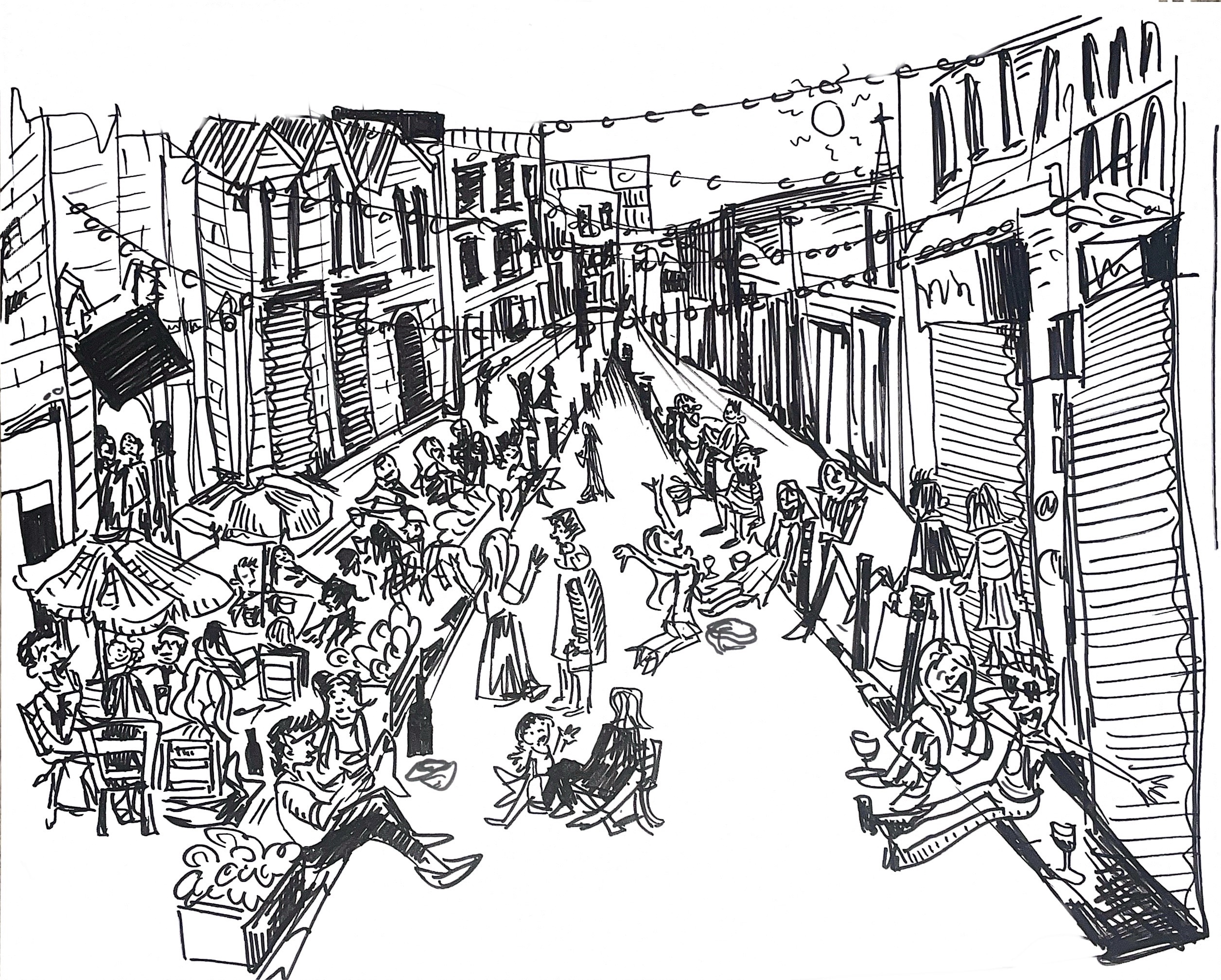
There’s a particular kind of university afternoon that happens somewhere between the last lecture and the first drink in which nobody really knows what they are doing. It is 4 o’clock, your lecture with that professor who has the most monotone voice in the whole world has thankfully finished, you miraculously don’t have piles of laundry or dishes to do, but it is all too early to go home. You’re sitting in that little cement nook outside the entrance to the Boland watching yet another seagull sit itself on top of the immovable globe. Someone that you know from somewhere — a lecture? A society? A night out? Maybe just the accumulated familiarity of having seen each other around the arts block enough times — joins you in your nook. You know their name, where they’re from, what they study, and they’ve got some fun physical features, like 15 piercings, that’s helped you remember them. Someone else you know from somewhere else comes by and mentions the Pav. A few people are going later, “Come with us.” It is objectively a very short sentence and you say yes. Or you say, “Yeah, maybe,” which is not the same thing at all. Then, several hours later, when you’ve realised your room really does need a hoover, your phone lights up: an address, a time, a location, people are already there, and somewhere at the end of the text bubble appears the inevitable if you want to come.
Suddenly, you are no longer sure what is happening because you could go, you were told you could go, but did they mean could in the ordinary sense of the word, or could in the strange social sense in which it means that nobody would stop you? It sounds silly but this is one of the great minor difficulties of being a person at university. There seems to be no official rules for knowing when you are invited somewhere. There is no little green tick beside someone’s name to tell you that you are definitely accounted for and a part of the plan. You simply develop a feeling for it, or pretend to. Perhaps this is why we spend such an unreasonable amount of time trying to decode the most unremarkable sentences. “We’re going later”. “You should come”. “If you’re around”. “Come if you want”. It is possible to spend an extraordinary amount of time thinking about what someone meant by “if you’re around”, when, in all likelihood, they mean that they were going somewhere and thought you might enjoy coming. Still, it matters. Not necessarily because the words matter, but because the thing underneath them does. Do you want me there?
There is something particularly high-pressure about that question at university because so much of university life is about finding out who wants you around and who you want around. You arrive with your old friends scattered across the globe, or perhaps without them at all, and suddenly you are surrounded by hundreds of people who are all doing the same quiet arithmetic: Who do I know? Who knows me? Who am I going for coffee with? Who would I text? Who would text me? For the first few weeks of September, the whole campus seems to be conducting this experiment simultaneously. People sit beside strangers and immediately begin trying to turn them into acquaintances, acquaintances become people you recognise, people you recognise become people you say hello to. At some point you realise you have started walking between lectures together. Nobody can quite identify when the friendship happened, it being beautifully made out of things too boring to remember. You do not usually remember the exact moment someone became your friend, you remember the accumulation of nothing: sitting beside each other, complaining about an assignment, going for coffee because neither of you wanted to go home yet, sending a stupid picture, missing the Luas, walking in the same direction, staying for one more drink because it was still too early to face your ridiculous flatmates. The people we end up spending a majority of our uni lives with are built, quite often, from very little. This seems worth remembering at the beginning of a new academic year, when there is a peculiar pressure to make everything count.
Uni is very good at selling the exceptional, with our Freshers’ Week and society balls, trips away, and that big group picture that circulates your Instagram feed for days afterwards. There is always some sense that somewhere, at some point, the real university experience is about to begin and you can spend a surprising amount of time waiting for your life to become interesting. When you first arrive, every new experience and every new person can feel like something you are supposed to do correctly. You have to push yourself, you have to make friends, you have to join things, you have to say yes, you have to make memories. You have to, somehow, become the person you imagined you would be when you pictured yourself at university. And then, eventually, you realise that this is just your life now. This feeling only hit me well into the second semester and I can’t pinpoint the reason why it took me so long but the long lists of ordinary things I’d do all day eventually led me to what I considered my every-day life now. Sat on a wall between classes protecting my overpriced lunch from birds, late to a seminar, in Lidl trying to use vouchers, complaining about the Irish weather to someone who will aggressively nod along, walking home with someone I met three weeks ago, sat around the dining table playing card games with my flatmates. In the most wonderful way, friendship can be entirely unimpressive. Maybe this is where the invitation becomes more interesting than it first appears. If friendship is built from ordinary things, then inviting someone into those ordinary things might be one of the most meaningful things we can do. It is easy to think of an invitation as something reserved for occasions, birthdays, weddings, parties, a dress code or a venue or at least a vaguely convincing reason to leave the house. The best and kindest ones are far less glamorous.
Do you want to walk over with me?
Do you want to sit here?
I’m getting food, do you want anything?
We’re going to the Pav.
I’m going to the library.
Do you want to come?
There is something almost embarrassingly simple about it, which is why perhaps that is why we are so bad at it. There will be people who seem to have made friends immediately, who already know where everyone is going and what everyone is doing. There will also be people who go home after their first day and wonder whether everyone else has somehow figured it out already. There is a lot of pretending involved in being new somewhere. It is almost like a show or a facade, the way we put on the outfits of our best selves. I say this with no shame or judgement. Meeting people when everyone is a slightly exaggerated version of themselves is half the excitement of September. Everyone is a little more confident, a little more sociable, a little more willing to tell a story to someone they have known for seven minutes. You pretend to be more comfortable than you are until you are, pretend to know where you are going until you know campus like the back of your hand, pretend you have somewhere to be until, eventually, you actually do. Something sweet about all of us doing this together, underneath the performance most people are hoping roughly for the same thing, just somewhere to stop performing for a little bit.
Honestly, this is the part of social life that we sometimes make unnecessarily difficult. We are so scared of being unwanted that we become frightened of wanting anyone. We wait for people to prove that they want us before we show that we want them, we do not want to invite ourselves, we do not want to seem too keen, we do not want to ask whether we are included, we do not want to risk discovering that someone we thought was our friend considers us an acquaintance. So everyone becomes very casual, if you want, no worries if not, you can come if you’re around. The entire university social system could probably be held together by the phrase no pressure.
But perhaps there should be a little pressure, and not the kind that makes you go to Drury Street for the fifth time this week when you want to stay home, or forces you to have a hundred friends, or tells you that the September-to-December stretch of the academic year must be the best four months of your life, but just the tiny pressure to be brave enough to ask. The strange thing about waiting to be invited is that everyone else may be waiting too. You can spend an entire evening wondering why nobody has asked you to come somewhere when, somewhere else, someone is wondering whether they would be weird for asking you.
Maybe we spend too much time trying to work out whether someone else has decided we belong, when belonging is often something much less official than that. An accumulation of everything, big and small, that happens in your new life is exhausting enough. The day becomes meaningful not because anything extraordinary happens, but because someone is paying attention to it. Perhaps this September we could stop waiting for belonging to announce itself and make it a little more ordinary, a little less intimidating, a little less dependent on whether somebody uses exactly the right words. There is no perfect invitation. There is no precise point at which an acquaintance becomes a friend, no sentence that guarantees that you belong.
After all, there is something very nice about a university afternoon in which nobody really knows what they are doing. That boresome lecture is over. You have nowhere particularly important to be. The evil seagull is still sitting on the globe. Someone is going to the Pav. You’ll find that you feel confident and comfortable enough to join them.

Leave a Reply