
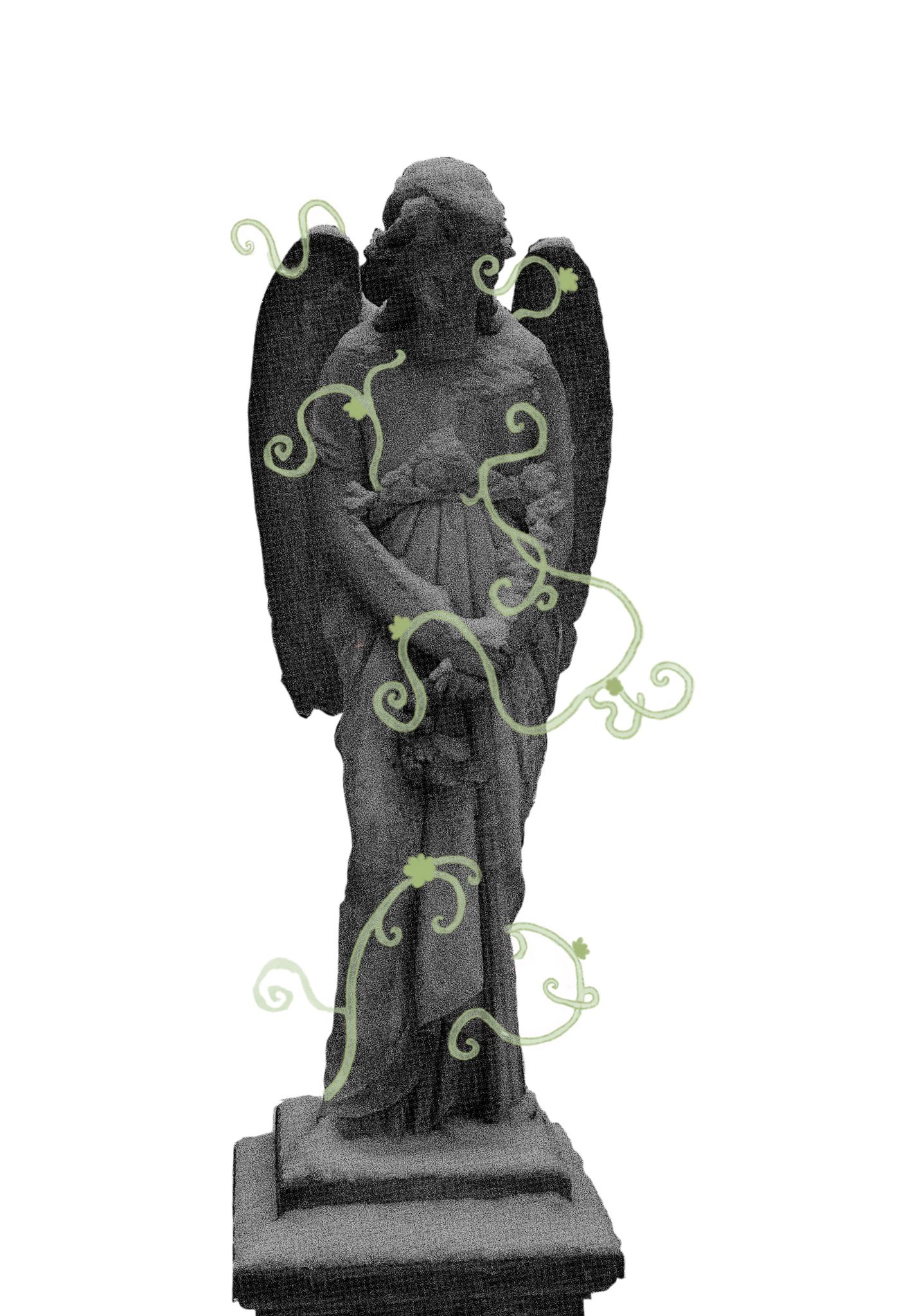
(“One can survive everything nowadays, except death…” – Oscar Wilde, “A Woman of No Importance”)
In Schöneberg, St. Matthäus cemetery sits between a train station and a biweekly Turkish produce market. Kelp-like ivy clings to its large arched entry, and a soft hill slopes through neatly parted rows. German graves are leased for 25 years, the time it takes for bodies to decompose. After that nothing but nails and rings remain.
St. Matthäus is not an unusual cemetery. There is a chapel in which funerals are held, peeling plastic signs preaching graveside etiquette, and old men bending over headstones to scrape at stubborn ferns. But if you know where to look, all cemeteries are home to certain oddities. At St. Matthäus, stuffy Prussian nobles neighbor the empty graves of exhumed Nazi-resistance fighters. AIDs victims rest in memorials a few meters down the path from the Brothers Grimm. In the summer, St. Matthäus is nearly silent. Only the occasional shout from the market or rush from a passing train disturbs the rustling green trees. When it snows, as it has this winter, red plastic candles faithfully glow beneath a tidal drag of snow.
St. Matthäus, while much like every other cemetery, could also only exist here, in Berlin, between a train station and a Turkish produce market. Nestled just inside its imposing entry sits Café Finovo, the first cemetery café in Germany, acting as a meeting ground for young people with a taste for the bizarre and old people who stop by on their way to tend graves. Originally opened by cabaret artist and gay-activist Bernd Boßmann after the loss of his friend, Finovo was created as a space for the living, “to pull life a little further into the cemetery.” Finovo means both beginning and end. There is only one “n” in Finovo because Boßmann believes an ending “already contains the new within itself.” Here, on jarringly colorful folding chairs and under the casual supervision of chainsmoking waitresses, life and death meet.
This kind of meeting ground, sometimes found in cemeteries, is dying out in a culture obsessed with escaping death. From anti-aging interventions to biohacking technology, many innovations seem designed to distance those who can afford it from their mortality. At the same time, body-horror blockbusters present aging bodies as monstrous while immortal digital worlds casually encroach on our everyday lives. Yet it is not only death but also dying which is being amputated from our cultural discourse. In her kitchen, my German grandmother who grew up next to a cemetery reminds me: “death used to be a part of life.” After her father returned from the war with a wound in his stomach, her mother began working odd jobs to feed their children. One of these jobs was collecting and reselling discarded cemetery flowers. My grandmother, whose hands shake when she places food on the crowded kitchen table, tells me that people used to die at home, and that afterwards, the community would come and sit with the body and cook for the bereaved. The corpse would often rest in the house for days before burial. This change in our cultural proximity to dying makes her uneasy, but it does not make her want to spend time in cemeteries.
In some ways, German cemeteries, always efficient and pragmatic, are an ironic place to explore mourning and mortality. On a sunny afternoon in February my godfather and I walk through the cemetery on which he spent a large part of his youth. In the 1980s, small-town cemeteries were a space for outsiders: queer youth, artists, and members of the punk and goth scenes. Now, his mother lies buried here. After 20 years, her lease is about to expire. A gruff cemetery grounds keeper has told my godfather that there is no reason to renew the plot, nothing but a wedding ring is left of her. This is my first time at her grave, and only the second time that I am meeting her. We have brought her flowers and carefully adjust the shells lining the base of her headstone which my godfather collected in her birthplace, Portugal. My godfather speaks of her to me in a way he has not before. He tells me they will take what they can of her headstone back to her ocean-lined home after the grave is dissolved. It does not feel like we are standing over empty ground.
My mother named me on a cemetery, but not at St. Matthäus. My mother is a German Catholic but she named me on the largest surviving Jewish cemetery in Europe. There, between fallen trees and pebble-lined headstones she found a German name for her half-American, half-Jewish daughter. Friedhof Berlin-Weißensee lies in the city’s north-east, about 2,5 kilometers from the lake promised in its name. There is a lot of life on Weißensee–its 42 hectares of forest and mausoleums are frequented by the surrounding neighborhood’s young families and joggers. Because the dead are not embalmed and coffins are held together by wooden pegs instead of nails, death on Jewish cemeteries brings with it a flourish of plant life which spreads, uncontained.
For many German Jews, cemeteries like this one stand out against a background of memorials and cenotaphs. Between the walls of this cemetery lay the bodies of people who were buried as individuals under their own names. Weißensee in particular was a place of life for Jews in Nazi Germany because it was protected by rumors that it was haunted. In the documentary Im Himmel, unter der Erde, Holocaust survivor Harry Kindermann explains: “For the Nazis, this Jewish cemetery was shrouded in superstition. That is to say, there were apparently rumors going around that something wasn’t quite right there. There is some kind of ghost…” Weißensee was haunted, not by ghosts but rather people trying to escape deportation. While most Jewish cemeteries were destroyed by the Nazis, Weißensee–and those hiding there–remained largely undisturbed.
St. Matthäus and Weißensee offer different ways of reading Berlin. Their paths, like all cemeteries, retrace the world around us, neatly parted or overgrown, the interwoven strata of local and personal histories. For the last three years, I have intermittently found myself in these cemeteries. Maybe this is because my American grandparents, who both died in this time, are not buried in a cemetery. Counter to Jewish tradition, they were cremated, and their ashes are spread over different corners of the Arizona desert. In the days after their deaths, I spent hours at St. Matthäus and Weißensee. There, under green awnings and between the mossy graves of strangers, I could imagine their ashes washing up to me, the gates of the cemetery like a leaning shoreline.
Or maybe, for the last three years, I have intermittently found myself in (German) cemeteries because I moved away from Germany, to Dublin. Cemeteries have long been a space in which we mourn our dead and begin to confront mortality. But as a potential meeting ground between life and death, they are also places in which we can think about the way we want to live, and how we want to be remembered. Whenever I am back in Berlin, I am pulled to my cemeteries. They allow me to acknowledge how time has passed since I was last here. I have never been to a cemetery in Dublin. Instead, I find a feeling much like the one I have on cemeteries when I lower myself into the Irish Sea every Sunday to swim.
A few days before returning to Dublin for my last year at Trinity, I went to Weißensee with my mother. We found eight Mathildas buried there. Maybe there are also Mathildas buried in Dublin cemeteries, but I have yet to find them.
On a Friday in July, I take the metro to the Père-Lachais cemetery in Paris to see the graves of Gertrude Stein and Oscar Wilde. Père-Lachais, like St. Matthäus, rests on a small slope. Unlike St. Matthäus, it is surrounded by a green area where ashes are spread. It is one of the last days of the summer heatwave and only few people seem to be visiting the cemetery at this hour. I share the shade in front of Wilde’s grave with a woman my age; we shyly gaze through the protective glass smudged with kisses at the offerings of those who came here before us. She sits down to write, I walk back towards the entrance gates. In the time that has passed, a group has formed, dressed in black and huddled around a woman in mourning, half sprawled over the rope separating the path from the green. They seem to undulate under the burning sun. The grass is streaked with white, almost like light breaking through the depths of coiling seas. I find another way back to the large arched entry, a gate that is not overgrown with ivy and does not rest between a train station and a produce market. Somehow, the mourners have caught up with me. A watery breeze sweeps us through the gate like a tide rushing towards sun-warmed stones.

Leave a Reply