
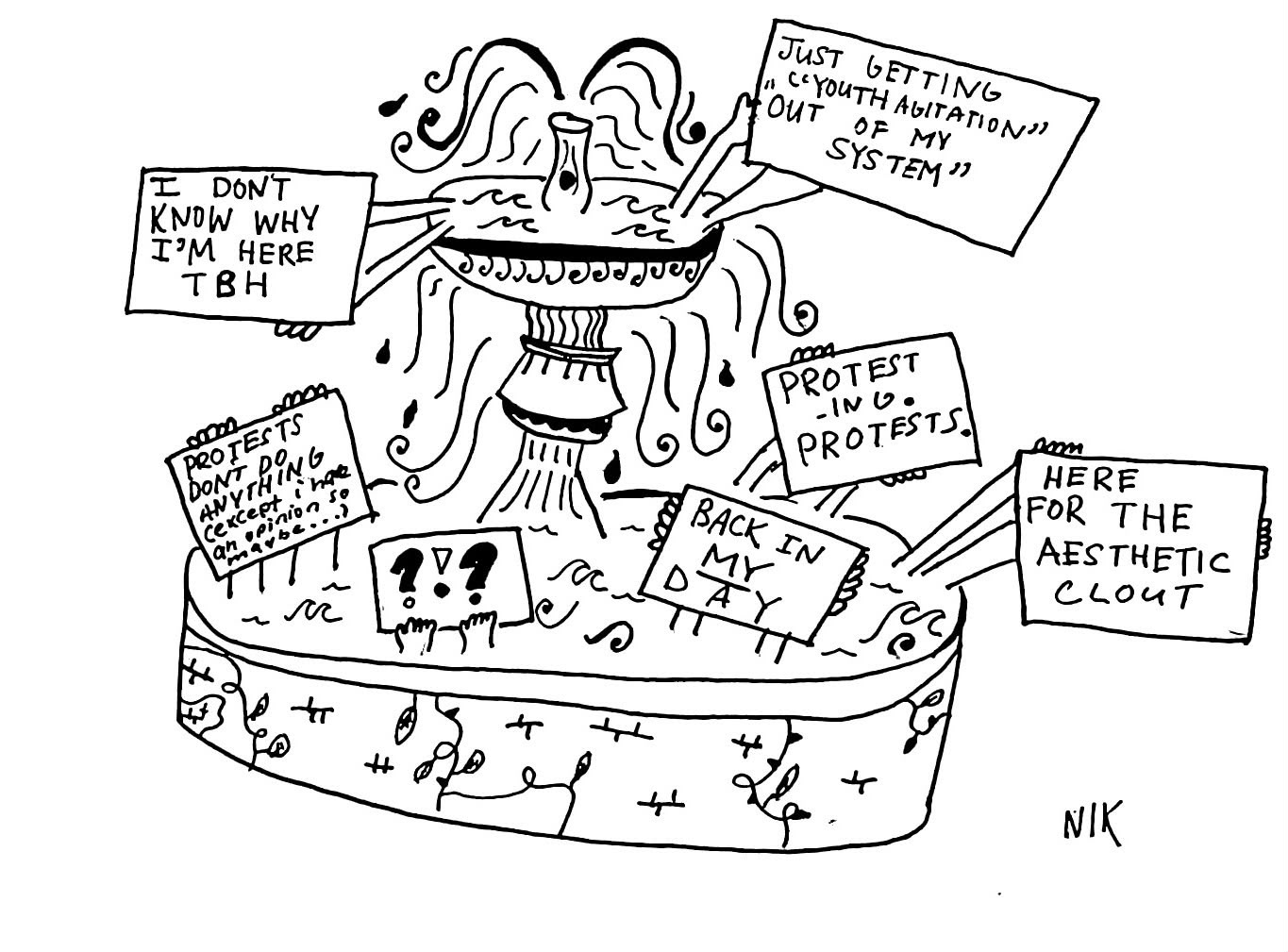
In the last month, from France to Albania to here in Ireland, protests have erupted from a particular, yet not unfamiliar source: students.
The image of the student protester is iconic and for good reason. Historically, students have been a fierce point for change, facing and challenging oppressive and repressive environments. From resistance against the Nazi German state and the Civil Rights movement to protests against the Vietnam War and the Apartheid in South Africa, student protests have had an impact far beyond their immediate university context, connecting and driving political change. Yet, it can sometimes feel that these protests become defined by a particular (un)intentional romanticised image. On the one hand, this image is often co-opted as a self-idealising political identity, particularly within elite leftist circles, while on the other hand, is capitalised on by critics of the protesters in order to categorise them into a belittling, unagentic, and amorphous mass. The symbolic appeal of the protest can sometimes override the lived realities of those involved in protest movements, yet the romanticisation of the student protest has ultimately figured into youth movements in unexpected, productive ways.
Since finishing undergraduate, joining the workforce, and then entering back into the university context as a postgraduate, I have noticed the ways in which students’ dedication and motivation are both rare and incredibly useful. However, the issue with the “student protest” aesthetic is that it places protesters within one fluid hall of “those rambunctious, outraged students.” Without reason, student protest is sometimes instinctively constrained to youthful rebellion. The images that we carry shape and limit our perception of what we believe can be possible. Thus, reducing these protests to the “student” part and image can belittle their causes as simply a result of youth rebellion. In other words, the cause doesn’t matter because “the students just need to protest something.”
Characterising the student protest as solely youthful rebellion further limits action, passion, and involvement with politics; taking public action becomes merely something to do while young as a rite of passage, something to “get out of your system” for when you gain sense with age. While the issues that students are passionate about are absolutely not confined to the university, as can be seen with cost of living or pro-Palestinian protests, the constructed image of the student protester has the power to define and confine political passion. Reducing to the aesthetics of the “student protest” means discarding the origin and boiling point for turmoil. What is transmitted is that radicalism is a result of age rather than real, urgent need.
During my undergrad, I went to Sciences Po Paris and UC Berkeley. I am no stranger to the romanticised protester. I found myself often adopting a similar position as Boomer conservative pundits decrying the mindless bandwagoning of Marx mania. Not because I disagreed with what was being protested, but rather because many — very importantly, in no way all given that there were many student protesters who have given their entire life to fighting for a better life for others — student protesters I encountered were focused on the power and prestige that organising gave them. Joining the history book hall of fame of the “noble” student protester that this widespread image has brought about seemed to be their ultimate goal and priority.
Yet, as I grew in passion, I realised that these “performative” (Gen Z’s favorite word) encounters were completely separate from my own and shouldn’t limit my own involvement. As I increasingly attended protests while at Berkeley, I came to the following realisation, which was very unfortunate for my ego, that all the seconds I spent judging and trying to pinpoint whether other protesters were there for the aesthetic, instead could have been used to make a real difference. Did their aesthetic motives matter in the end? They were showing up. They were spreading awareness. Whether knowingly or not, the romanticisation of the student protester was being used to create the image-conscious Gen Z student protester who was actually leaving a positive impact. Style and substance can absolutely coexist and, indeed, support one another.
Those involved in protests driven by a self-idealised construction of themselves and the self-obsessed grandeur (seeing themselves as the hero of the story) were ultimately making some degree of difference. If the goal of the protest is to draw attention and mass participation, this then becomes an effective marketing strategy, so to say. It allows a model for students to see how their participation can actually make a difference. Within issues that can feel abstract, drawing upon histories of students that were just like them, that went into the same classrooms, dealt with similar daily issues, can emphasize the forgotten point, inside and outside the university, that your actions do matter. Seeing yourself within a long tradition of the “student protester” can add possibility and potential to your own personal role within politics, a powerful lesson that has no reason to be confined to university years.
The danger, then, falls in reducing these movements to the images and aesthetics that they carry to a student protest as, contradictorily, those who idolise it reduce it through privileging its style and disregarding the very real sacrifices of student protesters. Considering the “student protest” and “student protester” as an aesthetic in the first place simultaneously trivializes and lays unjust claim to legacies of students facing violence and risk for their belief in and subsequent action to institute positive change.
Despite my past skepticism over protests, whenever I have been involved in protests or boycotts, the number one response I get is: “why would you get involved, protests don’t work?” or “yeah, the issue is important, but protests just don’t do anything.” Every protest I have been part of has been driven by the hope that your actions can have an impact. Regardless of the motives, you are there and there is power in numbers.
Once again, if the point of purpose is to draw attention, the fact that we are speaking about a protest and the fact that we remember protests that happened 60 years ago, in and of itself proves the point of having a protest to begin with. Protests draw attention and spark conversation. The fact that the image of the “student protester” is so often used authentically and inauthentically in an aspiring nature proves their power so often degraded by its skeptics saying it is just meaningless, youthful rebellion. This understanding is not just limited in its designation, but also in how it dissuades action.
Let us reframe this argument to the much more useful question: What can we learn then from the student protester? And their image?
While the university may have a particular set-up primed for effective protest participation, the “student protest” has become a fact of many extremely different university contexts. In my case, I saw how students approached and adapted to larger and smaller contexts, how different groups could be brought in, how issues could be better negotiated, how plans of centralisation, distribution, garnering protest attention and passion had to be altered to its context. If being a student is about learning and preparing for life post-university, why must this fountain of youth rebellion end at the “student protest”?

Leave a Reply