
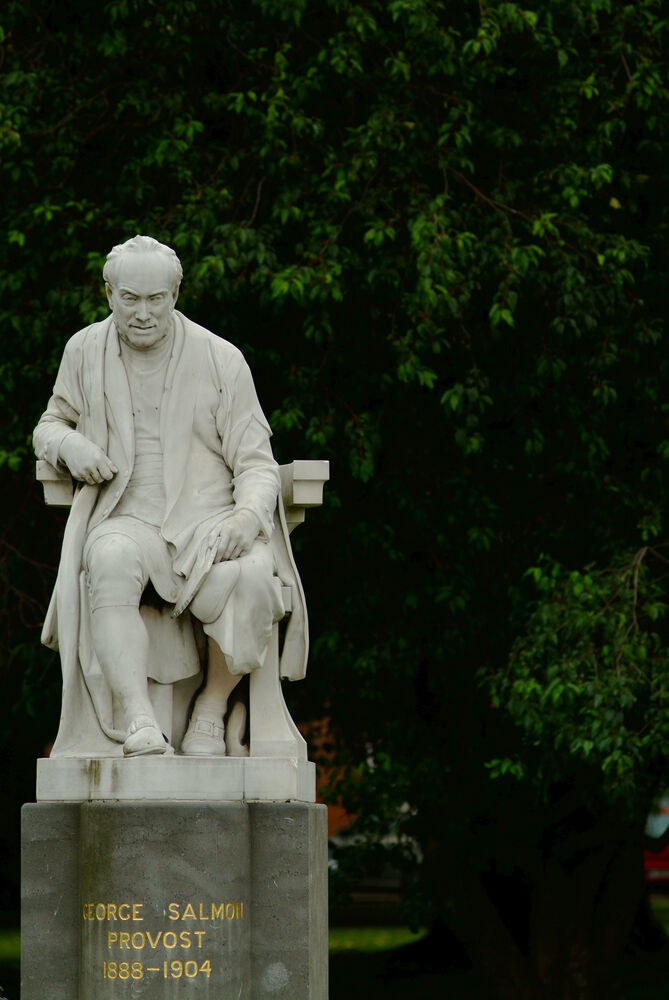
I was talking to a friend of mine the other day, a recent graduate from UCD, when the inescapable question of Master’s programmes came up. I was surprised to hear that she was staunchly opposed to following up her degree in Trinity College. “Why,” she asked me, “would I ever want to study in a place that has only let women and Catholics study there for the last 100 years?” I was shocked by her logic in that it was so fiercely opposed to my own. I always saw my position in Trinity as a Catholic woman as a source of pride, as a means of proving the misogynists of the past wrong. I enjoyed my position, in some ways, out of spite. But our conversation did get me thinking and I suppose it is a rather strange sensation to walk across front square every day under the beady eyes of a man who would have sooner died than see me at home in these our hallowed halls, to walk across front square under the gaze of former provost George Salmon, the man, the myth, the misogynist.
George Salmon, who presides over campus on his plinth beside the Campanile was Provost of Trinity College from 1888 until he died in 1904. He was a distinguished mathematician and theologist. He first entered Trinity College in 1833 at 14 years old and became a mathematics lecturer at 21, writing several key works in algebraic geometry. He was an ordained priest for the Church of Ireland and a Professor of Divinity. He was also one of the main opponents to the campaign for the admission of women to Trinity. The aforementioned campaign started in earnest in 1892, four years into Salmon’s tenure, when the Central Association of Irish Schoolmistresses (CAISM) presented a memorial of over 10,000 signatures of Irish women asking the Board of Trinity College to open their doors and degrees to women. However, the Board did not even acknowledge the petition until the following year and in 1895 the request was refused – proclaiming women: “A danger to the men.”
It is strange to consider Salmons’ refusal of the request when you consider his life outside of Trinity. Salmon was once a member of the council of Alexandra College, now a fee-paying girls’ High School but then providing third-level vocational training to women, and had supported girls competing on equal terms with boys in Intermediate examinations. His daughter had even acted as a coordinator for the Examinations for Women and was a member of CAISM. And yet his words still echo infamously around campus: “Over my dead body will women enter this college.”
It seems almost ironic, then, that immediately after his death in January 1904, Isabel Marion Weir Johnston became the first woman undergraduate to successfully register to study in Trinity. That year there were 40 other registrations which marked the Trinity’s first intake of female undergraduates.
Admission did not mean free study for women however, and Weir was not even allowed to attend lectures for the first few months. Women were not permitted to live on campus (Trinity Hall was established in 1908 to house female students) and they were forced to leave College grounds by 6pm. They were confined to separate dining rooms and cloakrooms and the ‘Rules for Women Students’ required all women to wear a cap and gown when on campus, or risk being marked absent in classes as “academically naked”. Despite the fact that Salmon withdrew his formal objections to women entering Trinity in July 1903 he still remains the symbol of women’s tempestuous early relationships with the College. So, it’s no surprise his statue’s prominent position on campus has come under much controversy over the years.
The statue erected to commemorate Salmon was created in 1911 by Dublin-born artist John Hughes and has been displayed in several different locations over the years. Before it was placed in its current home in Front square it could be found in the museum building where it was vandalised twice in the early 1960s. In February of 1961 and March of 1963 the monument was defaced with red and black paint and creosote, respectively. After the first attack The Irish Times quoted a student as saying: “it was about time – and you can quote me on that.” It was moved to its current position in 1964, allowing Salmon to look out upon the different generations of students coming and going, and despite his many years committed to this college and to academics, the majority of students are not happy to be looking back at him, a symbol of our long history of conservatism.
We are living in an age where we are increasingly aware of how our public spaces engage with history, and the question of whose voices and legacies we are forced to interact with has become unavoidable. There exists a deep-seated dissatisfaction with such commemoration of historical figures with troubled personal lives and the attitude seems to be to rip it all down and start anew. This sentiment was vividly expressed in 2020 when the statue of Edward Colston, an enslaver, was forcefully toppled in Bristol and thrown into the city harbour during a Black Lives Matter protest. This incident was an incitement for change, igniting a nationwide discussion. This act catalysed an unparalleled public reflection on Britain’s entanglement with its history of slavery, leading to the removal or modification of nearly 70 tributes to figures associated with enslavement and colonialism. Simultaneously, efforts were made to contextualise and redefine the legacies of certain contentious figures, as seen in the addition of explanatory plaques to statues of William Beckford and Sir John Cass.
It is not so easy to remove all disputed effigies from the public sphere as the aforementioned toppling may suggest, especially if attempts are being made to do so diplomatically. This is particularly highlighted though the disputation surrounding the statue of Cecil Rhodes at Oriel College in Oxford. Rhodes was a white supremecist whose actions and ideologies were part of the foundation that perpetuated the system of apartheid in South Africa. Understandably, monuments honouring his legacy of colonisation are unwelcome internationally and a global movement known as Rhodes Must Fall was founded in 2015 at the University of Cape Town, to challenge his commemoration. Last year, Oriel College also expressed its intention to remove Rhodes’ statue, a decision supported by an independent commission, yet the movement has come up against some obstinate obstacles and, despite protests and petitions for change, the College has refused to remove the statue for financial and legal reasons.
So, what to do about the elephant in the room or, more accurately, the statue in the square? While Salmon’s sins are not as stacked as Colston or Rhodes, some students have called for his complete eradication, much in the same stream as stripping the former Berkeley library of its title. Others, myself included, claim that the statue is a sign of how far we have come. Annie, a fourth-year European studies student, suggests that the college should not remove the statue but, instead, relocate it to a less prominent location. This sentiment is echoed in the words of Madison, a study abroad student visiting us from the States, who claims that she was not expecting to see Trinity campus dominated by so many male statues and argues that we should erect more monuments to honour the female students of our past and their struggles. What about Sydney Elizabeth Auchinleck who became the college’s first chemistry graduate in 1908? Or, Olive Purser, the first woman to be made a scholar at Trinity? Elizabeth Maxwell, the first woman to join the College’s staff, when she was appointed lecturer in modern history in 1909 or, even, one or all of the ‘Forward Five’ — Barbara, Maureen, Joy, ‘Pic’, and Maura — who dressed as men and stormed the dining hall in 1931 to protest women’s exclusion from it?
Nonetheless, whether it stays or goes, the statue is merely a symbol. The eradication of a symbol can and will not eradicate the history. Honestly, who would we be if we wanted it to? While George Salmon represents a lot of things to a lot of students, especially to our female dominated population, his statue remains as a reminder of the big shoes we have to fill as students here. It is so easy to take for granted the accessible education we are all privileged to but allow yourself to feel the history of the campus you move through every now and again, allow yourself to feel a part of something. When Salmon’s stare falls upon you do not cower, do not duck your head and run to class. Do not let the conservatism of the past alter the future that we’re making now. Walk tall, you have earned your place, you will never stop earning your place here. Smile in the face of those who said you’d never make it. Be a distraction. Be a danger. Above all, don’t break tradition. Be sure to get a picture with Salmon upon graduation — it’s what he would have wanted for sure.

Leave a Reply