
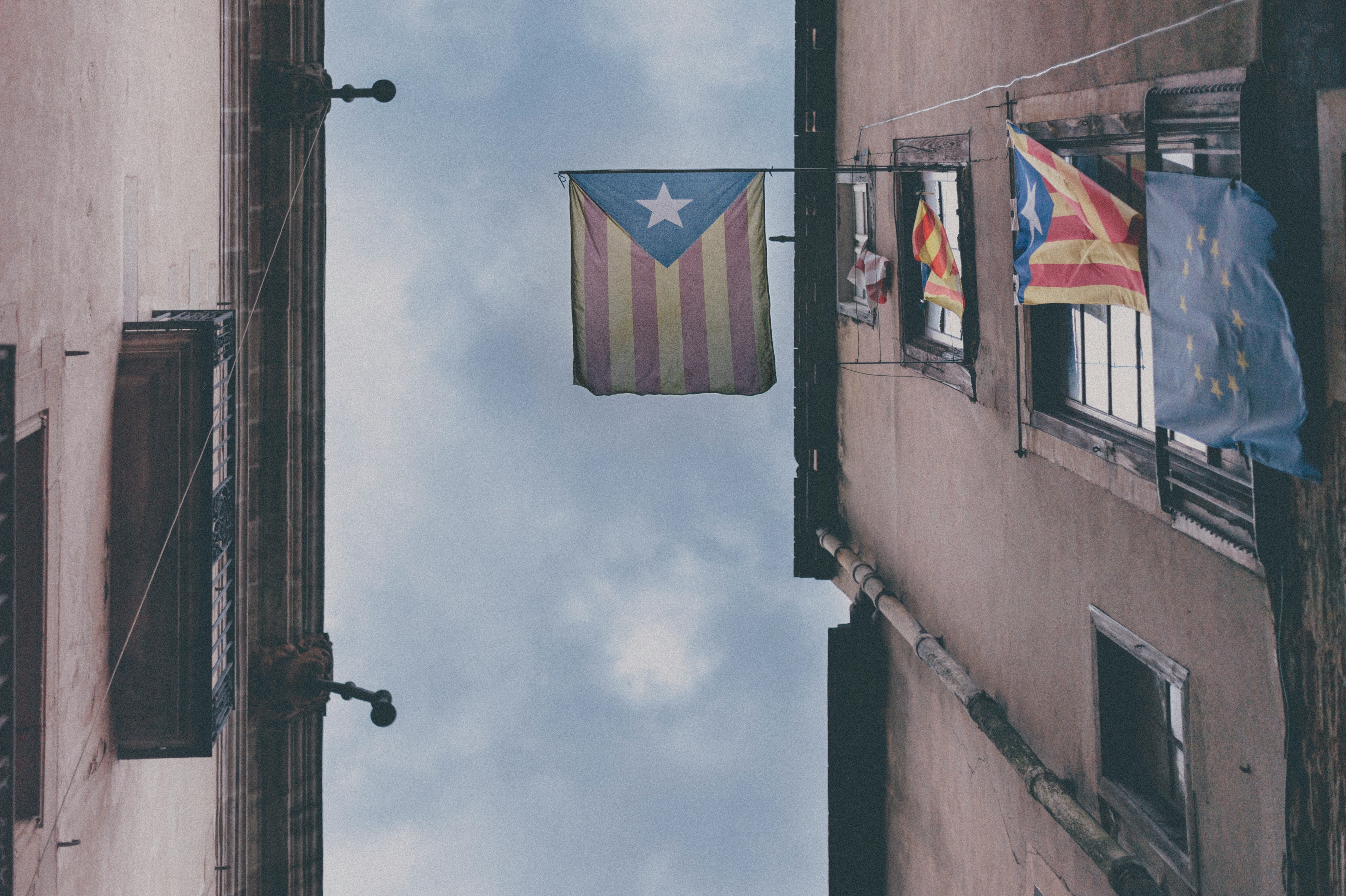
“They have, there is no doubt, a generosity, a species of nobility, that do not really belong to the twentieth century”, wrote George Orwell about the Spanish people. The 21st century, however, may prove to shake this belief for, in a globalised and late-stage capitalistic society, even some Spaniards have hardened.
In his 1938 book Homage to Catalonia, set partly at the front line of the Spanish Civil War and partly in Barcelona while on leave from fighting, Orwell lays bare his frustrations of war and politics, which would eventually culminate in his most prolific writings, and opens to the public intimate details of his routines during this tumultuous period of his life, and of European history.
Seen at the time to be the most pressing political question for the new generation of Europe, and now regarded as a rehearsal for the Second World War, Orwell acutely addresses the political heart of this conflict, and boldly diagnoses the failures and redemptions of the Republican Army, particularly his communist militia.
The circumstances of his time spent in Catalonia thus couldn’t differ more starkly from my own. I have often joked – to my mother’s disapproval – that Erasmus is the best holiday I’ve ever been on, and as I near the end of the first of two terms I am set to attend at the University of Barcelona, I believe myself to be fairly acquainted with the city, especially its most tramline-esque nightclubs.
However different our experiences of Barcelona and its surrounding countryside may be, reading Homage within my first month of arriving here provided me with not just a needed context of Spain’s socio-political history, but also a grounding in Catalonia’s personality and people. It was through this reading that I, too, could view Catalan society from a foreign, and distinctly anglophone, perspective – particularly regarding the region’s politics, which often accurately represent wider European issues, and subversive cultures, namely the youth and queer communities of the capital.
“This is not war”, Orwell was once told by his commander, “it is a comic opera with an occasional death.” This perhaps best exemplifies Homage’s view on its muse, the Spanish Civil War, and while Orwell does go into great detail about his everyday life at the front and his experience of street fighting in Barcelona, a major theme of the book is the political reasons behind it. He goes into detail about his frustrations of the lack of action in battle, the old and often futile weapons and ammunition that soldiers were given, and of course, the lack of an adequate supply of cigarettes.
He reserves an entire, substantial chapter to educate the anglophone reader on the political divisions that defined Spain at that time, in what results in a major literary catharsis for Orwell. This split, of course, acted as a prelude to Europe at war in the coming years, but its principles may still be applied today: a fragmented left-wing cause made space for the right and the far-right to entice disillusioned or indifferent centrist voters.
He further dissects the conditions necessary for such a grassroots revolution to be successful, he admires the Catalan working class in a considerate manner, and lambasts the foreign and Spanish press – which all serve as fruitful sources for his later works, 1984 and Animal Farm.
The socialist movement in Spain ultimately failed due to a military coup led by Francisco Franco, which was then followed by his near 40-year dictatorship. While the country gradually transitioned to democracy in the late 1970’s, and has been governed by a host of political parties (the current government being a democratic socialist party), Orwell’s experience of an idealised society where formal language has been abandoned and a gentleman is addressed as comrade has perhaps all but ceased to exist.
Dublin, the city in which I was born and have spent most of my life, no doubt has been plagued by social issues for decades – inescapable poverty, successive housing crises, lack of job prospects, just to name a few – however Dublin’s misfortunes pale in comparison to those of both mine and Orwell’s Barcelona. I admit that I have lived an extremely privileged life in whatever city I have lived in, and therefore wouldn’t know first hand the half of the daily struggle felt by my neighbours.
I recount a particularly troubling week in which I saw the same homeless man on my 15 minute commute to college every day. Walking towards me on Monday, I believed he was wearing normal trousers, but it wasn’t until my walk home a few hours later that I saw him from behind, and I realised that the back of his trousers were so ripped there was no fabric below his knee.
The following morning he was effectively wearing shorts, and over the course of the next three days his trousers decayed gradually, so much that on Friday he was left in just his underwear. I don’t believe I have seen such a physical representation of societal neglect in Dublin, and it shames me that I played a part in it in Barcelona.
It is evident that these issues are shared across the continent, which leads one to ponder if they share the same causes, too, despite them plaguing countries who are led by parties of varying political philosophies. Perhaps successive neoliberal governments (disguised as progressives) who have stalled to act on these societal issues in their respective countries may bear the responsibility for whatever major social, political, or economic upheaval we see in our version of the Roaring Twenties.
Aside from politics, Orwell goes to great lengths in order to describe Barcelona in intimate detail, a feature of the book which I highly appreciated. Much of one chapter recounting street fighting is based in Las Ramblas, which is now my daily commute to college. He shows a large appreciation for the city that he called home for a short while, in an attempt to portray the reality of this war in terms understandable to the anglophone world.
I only know these intimacies of Dublin, but I now view her somewhat as a ‘Barcelona-in-waiting’ – that is to say that I can see my home city maturing and evolving into my host city, in manners that range from the European expats at the core of the ‘young professionals’ community, to the various neighbourhoods with distinct and defining architecture.
Both mine and Orwell’s Barcelona is known for its liberal views on nighttime activities, and although the infamous brothels have been replaced by ‘coffee shops’, the revolutionary spirit of the city reigns supreme once the sun goes down. This, of course, is a prime opportunity for a vibrant and ever-expanding underground youth culture to foster, and this manifests itself above all else in the visually distinct youth groups in the city.
The Trinity College Arts Block may have met its match when confronted with the University of Barcelona’s letters courtyard, populated with literature and language students with high degrees of brooding, and more than questionable outfit choices. The Esade Law and Business school, on the other hand, would give a Blackrock graduation a run for its money with the amount of tan and light chinos (tight around the ankle, of course) that its male students boast. Much would be expected from a private Jesuit university charging close to €20,000 tuition per annum.
These stark divides may stem from just over 100 years ago now, representing the affluent and the working classes, the left and the right wing, the native Catalans and the emigrating Andalusians, however they are doubtlessly representative of a city that has something for everyone, a probable reason for Orwell’s infatuation with it, and a redeeming quality that no doubt attracts me and others here.
Finally – oftentimes, the least interesting aspect of a book is what’s written on its pages. For a book profiling one of modern Europe’s most significant wars, my physical copy of Homage appears to have been in the wars itself. Its dog-eared pages coupled with various coffee stains, as well as the slightly sandy quality of the cover due to hours spent in Barceloneta, portray a life of its own. Gifted by a university friend of mine, Hazel Scott, for my 20th birthday, I then passed it onto a school friend, a nameless UCD student who I now live with in Barcelona – thus opening myself up to slagging for my incessant underlining of Orwell’s words, and an alleged question mark after an apparently ‘self-explanatory’ sentence.
Nonetheless, Homage to Catalonia is an exemplar of noticing: from the smell of war and the sensation of getting shot, to the expressions on his wife’s face and the exactitude of historical retellings, Orwell painstakingly takes the reader through a particular moment in a particular place. While it’s fair to say that a great number of writers look up to him, our shared experience of this city, albeit in vastly different circumstances, has enabled me to notice the experiences I find myself in while on Eramus, and not allow these moments to flick by like a page in a history book.

Leave a Reply