
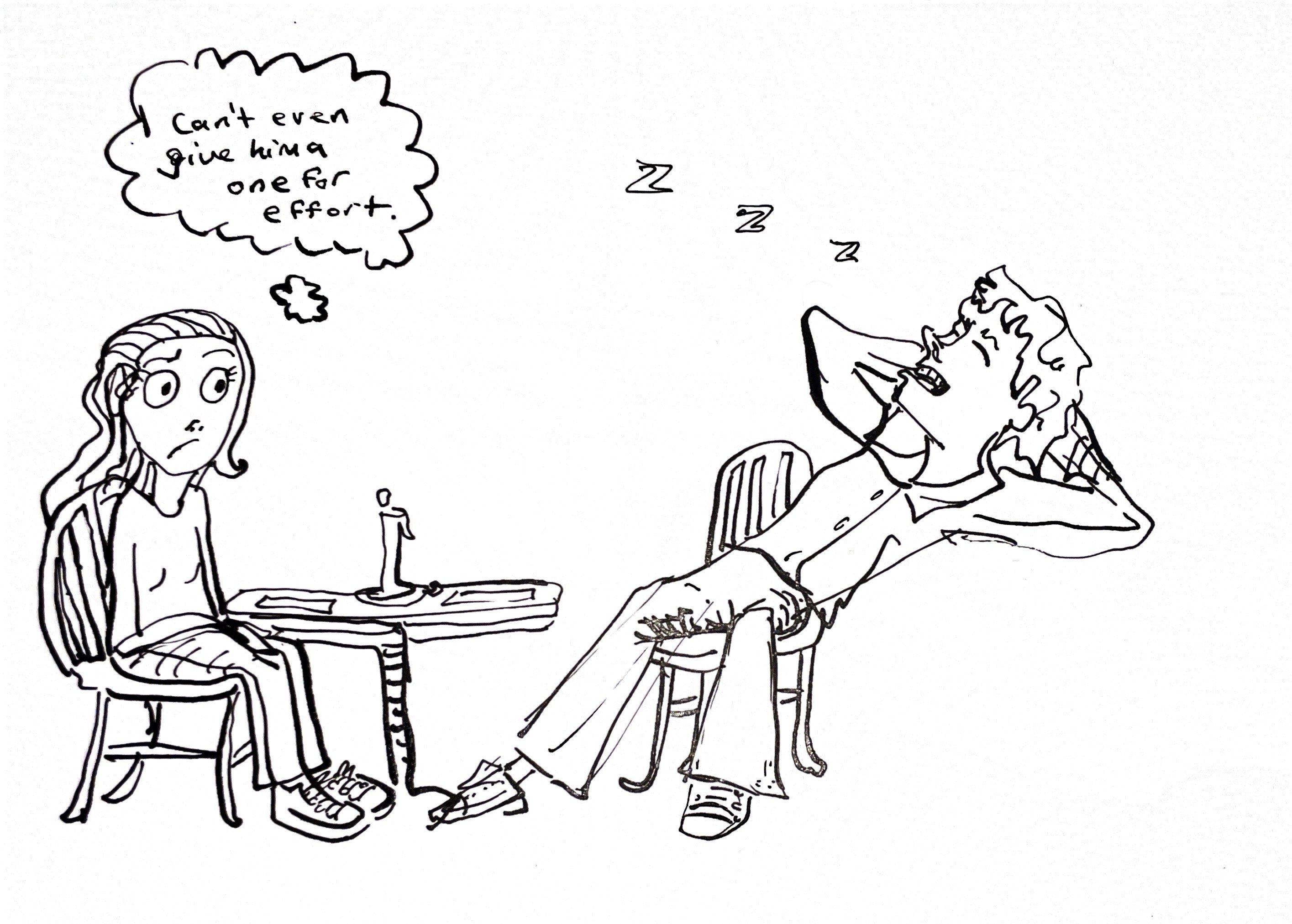
I met him for the first time one brutally and uncharacteristically warm day towards the beginning of April. His hair was shorter than his photo, buzzed down to his skull. He laughed when I pointed this out and abashedly admitted he thought of warning me. I didn’t tell him it wouldn’t have made a difference, he was still the most beautiful person I’d ever seen. The first encounter was lovely if slightly unremarkable. Coffee and stilted but sweet conversation. A walk around a strikingly green garden with stone benches and remarks that would over time become inside jokes, the kind that are only funny to those who share them. We began to see each other every day. With him, it was something rich, something cavernous and unexplored. It was fingers interlaced, kisses on the jaw and eye contact that felt like touching souls. I look back at the serene half-reality half-hazy dreamscape and remember only calm. A ship that had finally found waveless tranquillity amidst a current close to capsising. It was unfounded, unrelatable, and completely unexpected.
The days began to grow longer and questions approached along with the warmer weather. What were we to one another? I knew my answer but not his. I can bear, I thought, the not knowing. I tried to convince myself that it would be better to live with uncertainty and him next to me than to know and lose him. But the doubt began to spread through me until my fingers and toes ached with the precariousness. I kept waiting for him to bring it up, to confirm my most far-fetched fantasies or my quickly-consuming dread. But he never did. It ate at me until I could no longer ignore the incessant anxiety of a future awash with ambiguity. So I worked and reworked the phrasing and tone and killed myself over the timing. As if it would matter, as if I could say it perfectly in the right place and at the right time and it would change his answer. Of course, the tightrope we were treading on snapped and he said that a relationship wasn’t possible between us. I was devastated and shocked. I stayed in bed for days, cried to my friends and drank a few too many pints. I was stuck in this state for weeks before a friend, kindly but firmly, asked, “what was so special about this guy?”. And despite how heartbroken I felt, I couldn’t really say.
As the months went on and time stitched up the broken edges of my heart, I realised that I had created an idealised version of him. While our time together had been good, it wasn’t earth shattering or even comfortable. I had never felt like myself around him and he had never truly opened up to me. So why had I been so hung up on something that wasn’t right? How could I stop myself from being so hurt by something so wrong in the future?
In my own experience and for my other single friends, dating in Dublin has caused immense damage to our psyches. We often laugh and describe our friends in loving and healthy relationships as having caught the last helicopter out of Vietnam. I far too frequently find my mood determined by whether a man with a moustache and a mullet is active on Instagram but not replying to my texts. Spending hours debating if TikTok reposts were smoke signals or merely coincidental. Pouring over playlists and analysing the lyrics of each song. My quality of life has been completely dependent on whether or not I was getting the attention I craved. I would go through these easily predictable cycles: the meeting, the limerence, the disappointment. It was all-consuming and quite frankly exhausting. I realised that if I were to continue to date, something needed to change, and quickly.
One night, I was scrolling on TikTok and came across a girl explaining a spreadsheet she had made to help her approach dating through a less personal lens. At first, I scoffed at the idea. Dating is inherently personal, that’s what makes it exciting and worthwhile. But, at that point, I was willing to try anything to make the dating experience less painful.
I began by making my own spreadsheet. The idea is to create questions to ask yourself after a first date to evaluate whether or not this person is an ideal partner or even somebody you would want to see again. This is critical as, personally, even if I didn’t have a good time on the first date I catch myself wanting to go out with a person again purely for the feeling of being wanted and ‘courted’. Asking objective questions helps me to gauge whether or not it was a positive experience and disconnects the part of my brain that immediately jumps to looking at every date through rose-coloured glasses.
The questions that I came up with reflect what’s important to me, both initially and for a longer-term connection. They start more objectively: ‘Did he confirm the day of?’, ‘Was there good eye contact?’, ‘Did he ask good questions?’. They then veer towards introspection: ‘Did we laugh and have a good time together?’, ‘Was he my type?’, ‘Was I looking forward to physical contact?’. Finally, I ask myself, ‘Do you want to go on a second date?’ This last question may seem redundant, but after answering all of the above and really considering whether I enjoyed myself, it allows me to answer more truthfully, even if it’s just to myself.
The key to these questions is to create them with a yes or no framework. That way, one can proceed to answer them on a scale of one to three. One being yes or good, two being neutral or average, and three being bad or no. Answering each question with a one, two, or three then creates an average for the date. Because one denotes the net positive answer, the closer to one the date scores, the better it went and the better the connection is – objectively. Because not all questions will apply to all dates (e.g a question about whether he was kind to waiters or if the kiss at the end of the night was good), one can also leave the answer to that question blank and it won’t impact the average.
Initially, I was hesitant to try this after a date. After all, how would I feel if I found out my date was scoring me? It felt reductive and slightly inhumane. I was worried that I would spend the entire date making checklists in my head and getting lost in the numbers rather than the chemistry. But the anxiety that would creep into every aspect of my life when I wasn’t getting a text back was enough to push me over the edge. It helped that the first time I filled out the spreadsheet the date averaged at a 1.1, an extremely good score. It also helped that I ended up seeing this guy for a while before it ended circumstantially. If anything, having his score as the first in the sheet created a standard for the other dates that has allowed me to truly only accept being treated well – something that I, and everyone else, deserve.
The spreadsheet, as anal and even crazy as it is, has saved my feelings in more than one situation. Even after a date that scored an average of a 1.5, I found myself with a bruised ego when he said he didn’t think there was a romantic connection. While I hadn’t been dying for another date with him, the rejection naturally stung. Looking at the spreadsheet and seeing the cold hard facts that it wasn’t that great a date brought me back to reality and not a dream world in which he and I live happily ever after.
I’m still not sure, after all of this, if I condone the use of a spreadsheet when it comes to dating. It’s helped me, but I can’t shake a slight feeling of guilt when I fill out the numbers. What if they were having an off day and I misjudged them? It has been crucial for me to sustain a level of humanity with the scores, an understanding that a number can never truly represent a person. Deciding whether or not to see someone again based on a score might be sociopathic, however as a hopeless romantic with their head in the clouds of delusion, the numbers have helped me to see things for as they are, which isn’t always something worth losing sleep over.

Leave a Reply