
In October 1973 the first meeting of Ireland’s Sexual Liberation Movement (SLM) took place at Trinity. What started as a small meeting in House 5 would see the organisation of Ireland’s first gay disco, a landmark symposium on gay rights in Regent’s House and the Republic of Ireland’s very first ‘Pride’ demonstration in June 1974. Some fifty years after that initial meeting, the foundational place of SLM in the history of LGBTQ+ Rights in Ireland, and Trinity’s place in it, has been widely recognised. In 2023, Trinity’s LGBTQ+ Staff Network and The Provost of College highlighted the history of the Sexual Liberation Movement at the College’s annual Pride Celebrations. It was there that I had the privilege of meeting Micheál Kerrigan, one of the founding members.
Kerrigan, now a celebrated playwright, author, and activist, was born in the Bogside in Derry. In 1972, he was awarded a scholarship to attend Trinity and, ignoring protests from the local Catholic Bishop, arrived on campus armed with only ‘a tub of lard, a bag of spuds, and a chip pan.’ In Kerrigan’s own words, he was ‘completely and utterly, out of [his] depth.’
Finding his feet and figuring out his identity in between working shifts in the student bar in the Buttery, Kerrigan was one of ten – Ruth Riddick, Mary Dorcey, Mark McWilliams, Gerry McNamara, Hugo McManus, Peter Bradley, David Norris, Irene Brady and Edmund Lynch – who began meeting weekly in Front Square under the moniker ‘Sexual Liberation Movement’ in October 1973.
In a 2021 interview with Edmund Lynch, Kerrigan told the story of the group’s inception: “I was working in the bar in Trinity, collecting glasses and cleaning up. And this very strange group of people came in. They were different, you know, and they were all sat in the corner, and I was sort of attracted to them… So I went over and I talked, Peter said, “We have just started this sexual liberation movement, and it’s every…” I’m not sure, was it Tuesday I think? At eight o’clock, you know, in Front Square, as you came in the gate and turn right. “So would you fancy coming?” So, I did.”
The pamphlet advertising the SLM was aimed at homosexuals, announcing ‘there is a group for gay women and men in this area.’ However, the group’s discussions were broadly intersectional, ranging from discussion of poetry, literature and art to feminism, racism, gay rights, and colonialism. Contraception, divorce and homosexuality were all key concerns. Over the phone, Micheál reflected on the importance of the wider context of activism at the time: ‘At that time in the late sixties and seventies, you had the civil rights movement in America, the Troubles, you had the feminist movement… We were trying to make sense of the world and to connect everything up. It was a very exciting time.’ The broad scope of the concerns of the Sexual Liberation movement was reflected in its members, which consisted of both heterosexual and homosexual individuals.
Similarly, though the group met at and were based out of Trinity Campus, except for Kerrigan, then an undergraduate, Peter Bradley, a postgrad and David Norris, then a junior lecturer in the English department, most members were not associated with the college. Despite this, Trinity remained at the centre of the group’s operations; in February 1974, SLM organised a landmark two-day symposium on homosexual rights in Ireland. The group commandeered Regent’s House, at the time the Junior Common Room, hosting discussion from various speakers on the legal and social status of homosexuality in Ireland. The symposium sought to draw attention to the ‘Gross Indecency’ law that criminalised homosexuality, a holdover from the pre-independence 1885 Labouchère amendment enacted across the British Empire. Reports in the Evening Herald on February 17th 1974, noted some 200 people being in attendance at the symposium. Speakers included former Minister for Health Dr Noel Browne, a psychiatrist, Rose Robertson of Parent’s Inquiry and Professor of theology at Maynooth University Fr Ena McDonagh. However, it was the testimony of LGBTQ+ speakers, like Babs Todd, Editor of Sappho Magazine, that were truly radical. For Kerrigan, the symposium organised by SLM marked the birth of gay liberation in Ireland.
“We had Babs Todd get up to the podium in the afternoon. She said, “Thank you for inviting me here as a lesbian woman.” Now that mightn’t sound earth-shattering today, but she was the first person who got up on the podium and identified as gay. Well, the crowd got up and everybody applauded, and it was like a really uplifting thing, you know. This woman said she’s here, she’s in Dublin and she’s queer. It was great. It was just one of those spontaneous rounds of applause, and people got up and applauded. So that was it for me; that was the beginning.”
The group went on to organise Dublin’s first gay disco, held not in the Junior Common Room (due to restrictions by Estates and Facilities), but on newly acquired premises on Westland Row. With no support from College and no functional electricity in the building, SLM rerouted electricity from next door, sourced up a record player and danced to Diana Ross by candlelight.
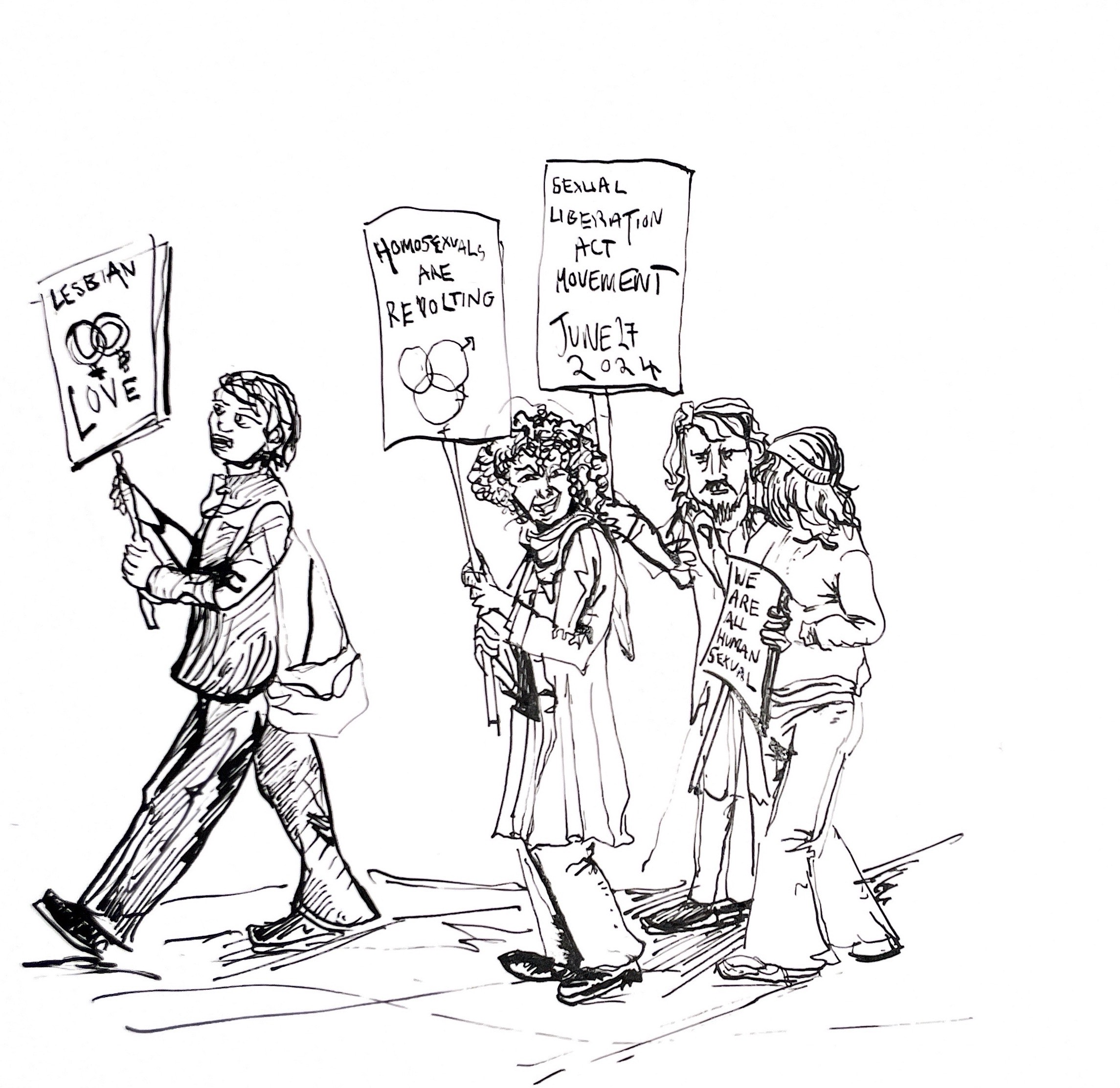
In June 1974 the Norwegian gay organisation Det Norske Forbundet declared that year’s Gay Liberation Day, June 27th, would be dedicated to the people of Ireland. In a demonstration of solidarity, members of Det Norske Forbundet picketed the British embassy in Oslo protesting the colonial law still in place in Ireland. Encouraged by their Norwegian counterparts, 12 SLM members, Kerrigan among them, picketed outside the British embassy in Dublin before moving to the Department of Justice carrying placards emblazoned with the slogans homosexuals are revolting, gay is good, and lesbian love. This was the Republic of Ireland’s first Pride demonstration.
The Sexual Liberation Movement was short lived; by the end of 1974, the group had split, with members David Norris and Edmund Lynch leaving to form the Irish Gay Rights Movement, aimed specifically at law reform. The road to reform would be long. It was only in 1993 that the law criminalising homosexual acts was repealed. With the establishment of the Hirschfeld Gay Centre in Temple Bar in 1979, and the first official Pride March in 1983 culminating outside the GPO, the theatre of protest moved out of Trinity Campus into the wider city. For the year of its existence however, Trinity campus served as the central backdrop for the Sexual Liberation Movement and all its shenanigans. In his latest play, ‘Nancy Boy Shenanigans’ launched at Derry’s Playhouse theatre this past august Micheál Kerrigan returned to explore his formative years as a student. Speaking over (a somewhat garbled) phone line, myself and Micheál digressed from my list of questions to reflect on the ephemeral nature of a single student’s experience on campus. With the student body refreshed in full every four years, memories of students and movements which have come before fade out of view and into history. In June 2024, Trinity Trails launched a series of ‘pride’ tours of campus that highlighted the little-known history of the SLM, among other LGBTQ+ facets of Trinity’s history, across campus. With Trinity Trails largely the domain of tourists however, one has to wonder whether a more permanent, student-oriented form of commemoration is needed.

Leave a Reply