
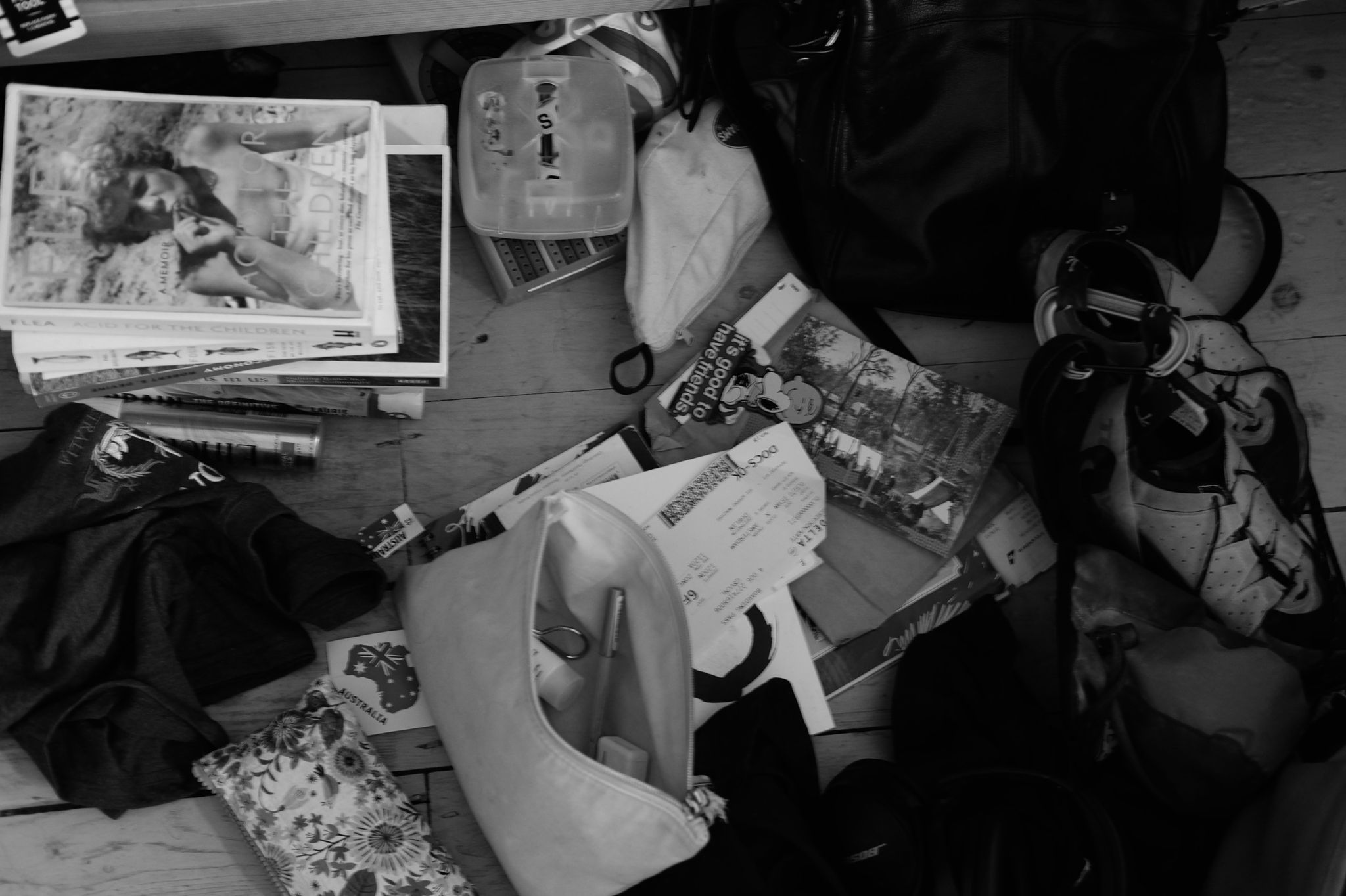
“You could host a flea market in here,” harks my flatmate, hovering in the door frame of my Dublin bedroom. She is right – my walls are hodge-podged with postcard prints and musical memorabilia; my shelves are lined with living and dormant cameras; my windowsills house feral plants and toy race cars. It is a traveling circus of items, painting a life of one person with many interests. I have accepted myself as a ‘collector,’ though my grandmother would prefer ‘hoarder.’
Now entering my final semester of my bachelors, deadlines are imminent. Those most daunting include capstones and future plans, though I similarly await the expiration of my yogurt in the top back shelf of my fridge (which is far too small). My deadlines, both major and humble, imply movement. Even the kefir cultures in my greek yogurt are bound to change their form. Particularly, in my mind I fast forward to the long-awaited and long-denied movement that will rear her ugly head towards the end of May – leaving Dublin. In anticipation of this change, I am reminiscing on all of my locational transitions. From home to school and back and forth, as well as Erasmus resettlement and countless Ryanair escapades, I consider my feet to have graced many a ground, both in temporary and permanent ways. As a tokened ‘hoarder,’ I can’t help but imagine the scenery of every space I have made my own and the things that set the scene. More than the windowsill statues and crooked canvases play crucial roles in my relocation. Stories are constantly told by the things that move with us, whether they be intended memorabilia or haphazard collections. After a journey I find my pockets stuffed with crumpled receipts, pastry remnants, irrelevant currency and rocks that I was totally going to convert into some cool jewellery (no, that time I really was going to!).
So, I’ve been racking my brain about the things that always seem to be with me. In all of my resettling into daunting rooms with blank walls and stuffy air, my decorations hold the recipe for making a space energetically liveable. The stars are my Tibetan prayer flags, linen multicolour squares exhibiting Tibetic inscriptions and Buddhist imagery. These exact flags have hung in every room I’ve ever lived in, from my Nevadan infant nursery onwards. Their presence offers the warm familiarity of my mother and her spirituality as well as being the protector of my space. Traditionally, prayer flags denote the movement of mantras of peace, wisdom, and compassion by way of wind. For these flags to serve as my rock in times of readjustment as well as reeducation in carrying myself in a new place is quite the parallel. By hanging them time and time again, they repeat incantations of authenticity and gratitude as I move with – and sometimes against – the wind.
Recently I have discovered a new beloved item, though her presence in my space has never been a conscious decision. Upon unpacking in Dublin for the third time, I found a sweet figurine of a girl, just shy of two inches tall, dressed in traditional Basque garb. She wears a white headscarf and a draped red skirt, and she is holding her teeny hands together under her bust. Her face is painted with a slight smile. I have no clue where she came from or how she ended up in my random-things-bag (amidst obsolete chargers and luggage tags). But somehow, she keeps turning up. I remember my surprise fishing her out of yet another random-things-bag when unpacking in Istanbul. From then on she lived on my bedside table, watching over my books and jewellery dish and the water glasses that soon piled up. She serves no purpose other than watching over her fellow trinkets, but her little frame warms my little heart. She wafts nostalgia through my space in a way that only one’s culture can. She fills my ears with the sound of an energetic Hegi, my mouth with flavours of tongue and garbanzo stew, and my memory with laughter from friends I haven’t seen for years. She mostly reminds me of my father, who probably had something to do with her being mine in the first place.
I’ve also been paying close attention to the things accumulated by friends and acquaintances – backdrops of dinners at mutuals’ and confidants’ apartments. During a recent trip to Munich, I met a kind man, originally from Egypt, and now a long-time resident of Germany. As someone who has moved through many countries, cities and flats, I asked what things reoccur in his spaces. For him, books are vital to completing a room. Over our conversation, aided by salted margaritas and crisps, he points out the most memorable books of his collection – those that he recommends to others. Over time, he has purged many books from his collection, leaving them on the streets when moving from place to place. This was striking to me. His book-lined shelves are kept company by horse figurines and thriving plants. They provide the backdrop for his and his partner’s home. But they also remind him of how he has impressed upon all the places he has lived; impressions in the form of open-fated roadside books.
A close friend in Dublin also shared his cherished item with me. His walls are methodically decorated with postcards and photos of friends, his recipe for filling his space. Among this ensemble is a print of his name in Chinese script, written in traditional ink brush. Though originally adopted from China, he resonates entirely with his Irish culture, from language to music to wit. He remembers getting the print while meandering through a Chinese street market with his mom upon returning to his birth city later in his life. He speaks of this token with a sense of awe – though he has no obligation to the culture of his origin, he feels drawn to his roots even if solely by acknowledging them. The script is blue-tacked to the wall alongside memories of his Irish upbringing, his items partnering the foreignness of his biological past with the comfort of his adoptive identity.
My other flatmate has a similar approach to what she carries. For me, the postcards and prints that decorate her walls portray her magnificent taste; in media, art, influence, and more. For her, her walls are the perfect canvas for her geographical anthology. She incorporates every place she has lived into every space she dwells, illustrating her adaptability and all the places that have shaped her. This room perfectly fuses the plethora of lives she has lived. Her kitschy Midwestern fishing collectables belong in the scene just as much as her Swedish abstractionist prints. Her tales of Minnesotan summers leave me with a thirst for murky lakes and melodic loon choruses. One of her most prized possessions is a wooden, postcard-sized sign originating from her childhood cabin on the lake. Hovering over a happy canoeing couple a vintage font reads: “Oh to be outdoors… Wish you were here!” The cabin is no longer in her family, but the memento immortalises those many stuffy summers spent eating Snickers salad and drinking cheap beer.
Another dear friend – the first I ever made at university – explained her travelling collection to me. Displayed on her mantle, previously on a windowsill, and originally in her family bedroom, are her grandmother’s rosary beads, her grandfather’s crucifix, and her uncle’s prayer book. It wasn’t until moments after her description that she realised their common Catholic theme. Her makeshift altar provides a crucial closeness to her family, especially over so many miles and the change that accompanies distance. The rosary given to her by her grandmother drapes over her frequented deck of tarot cards, a more relevant practice for her than the sacramentals. Her intention is for the tarot to cleanse the beads, not for any abomination towards her grandparents. Besides being a reminder of her family, she doesn’t quite know why these items always move with her. Yet, I observe her mantle as the perfect juxtaposing union of her spiritual life and her personal evolution.
While my flatmate acknowledges the adornments of my room from her stance in the doorway, she also notes that there is no shame in collecting. We love the things on our shelves, under our beds, scotch-taped to our mirrors and swimming in our jewellery dishes. It isn’t the form of the thing that we love, but the past that they represent. We love the people that live through them, the smells that waft through them, and the memories that exude from them. Snapshots of the countless people and places that I owe my path to live through my silly things. Because of this, I say no to minimalism.

Leave a Reply