
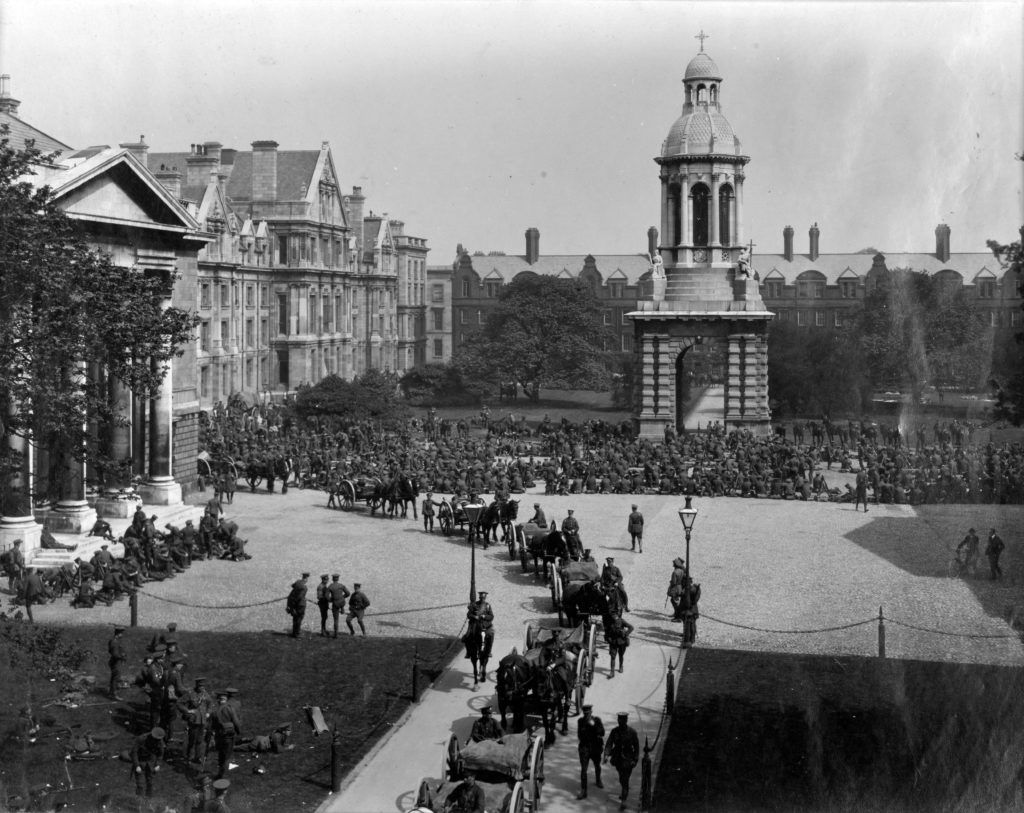
Since its establishment in 1592, Trinity College Dublin has stood in the centre of Ireland’s capital as an emblem of foreign rule. Originally founded under the name of England’s Queen Elizabeth I, the first professors and administrators of the university made no secret of its allegiance to the British crown, and its ambition to further the colonial cause in Ireland.
It served for centuries as the school of choice for the island’s ruling Protestant Ascendency, and up until the 1970s had comparatively very few Irish Catholic students due to broad socio-economic barriers to education and the Catholic’s Church insistence that permission must be granted in order for a Catholic to attend Trinity.
Of course, the campus that we go to everyday has changed much since those times, and now stands at the forefront of academic modernity with robust schools and a diverse student body. The progression to this current state was non-linear, however, and underwent various periods of opposition and acceptance throughout the slow march towards Ireland’s self-actualisation.
Trinity’s history of propagating colonial interests in Ireland has naturally resulted in the college’s less than favourable social and cultural reputation for being ‘elitist’, ‘out of touch’ or ‘not-Irish’ – to sum this up in one term: West Brit. Loosely defined as someone or something that maintains either an interest in or support of the British presence in Ireland – be this cultural, political, economic, militarily or otherwise – the term West Brit brings with it explicitly negative connotations in the Irish psyche.
From reading choice articles in Misc.’s archives from around the time that the Irish nationalist cause was at its most active (say 1915 – 1925), the label is well earned – one wouldn’t have thought that a revolutionary fervour was stirring in the country, for Misc’s writers largely ignored this.
While it wouldn’t be accurate to state that the 1916 Rising was a grassroots effort from the people in Dublin, it is surprising that the supposed intellectuals in Trinity at that time didn’t sense an air of change, or at least talk amongst themselves about theories of a burgeoning national identity.
Misc. took a break from publishing their weekly pamphlet style newspaper in the immediate aftermath of the 1916 Rising, and only returned to readers in the June of that year. What they wrote about such a significant event – which, arguably, occupies centre stage in the historical retelling of the birth of the nation – is telling of the privileged position that the student body occupied at that time.
In the opening editorial, Misc.’s top writers opined that “Trinity College, true to her traditions, has played a worthy if an unacceptable part” in what it first described as a rebellion. This part that the College played was “to defend our University against the attack of Irishmen, to be forced in self-defence to shoot down our countrymen” – certainly an interesting way to describe the series of events.
Perhaps the most delusional statement of all was their speculation as to why Trinity wasn’t targeted more severely by the rebels, writing that “we cannot help cherishing the hope that our College was defended by something even more powerful [than] the rifles and bayonets, and that the honoured fame of our university made the rebels loath to attack it”, adding that “the love of Trinity and the pride in it is the heritage of all Irishmen”.
This shows us not just a wilful ignorance to the reality of a life of struggle lived by people in Dublin (something which Trinity students are charged with to this day), but also a blindness of the political situation that provoked such a violent outburst in the Easter Rising. The latter is even more surprising from a group that would consider themselves at the forefront of political public opinion, backed by hours of lectures on relevant topics.
They wrote not about rebels who had been executed by the British army, nor of the infrastructure damage to the city centre, but instead focused their writings on “the efforts of the College servants” by crediting the two porters who closed Front Gates with “promptness and initiative”. They praised the kitchen workers for providing “tasty breakfasts” for British Army Generals stationed on campus, while also thanking them for maintaining the quality of dinners for staff and students.
Reserved for the very last paragraph was brief political analysis, in which they simply put that “if only the various rival politicians could be induced to spend a few weeks in the College we feel sure all difficulties would vanish”. They then quickly shifted to discussing a poem about a yellow primrose by a river basin in a confusing attempt to express their wish that this would all go away.
Reading through this edition of Misc., I didn’t expect to be greeted with revolutionary attitudes, or even light agreement with the Irish nationalist cause – which, for those interested in further readings, can be found in abundance in Misc. during the 1960s and 1970s, when the publication shifted to a magazine style and the student movement was at its peak. I was, however, surprised to read such a tunnel vision account of events.
Trinity has always been at arm’s length from broader Irish society. For good reason, too, with its unapologetic association with the British crown for centuries and proximity to privilege provoked by rampant social and economic inequality. A narrative has been born within this campus’ walls that this position is unjustified, and although in a contemporary context it is fair to question this – the historical roots of this are more than reasonable.
Misc., in its various guises, acted as Trinity’s principal publication for more than 50 years, only beginning to be rivalled by Trinity News in the 1950s, meaning that the brightest (or, at least, the loudest) minds flocked to our pages to voice their views on events. The first edition after the 1916 Rising largely ignores the reality and context of the events that took place that Easter – sadly only solidifying Trinity’s tarnished reputation as an institution alien to Ireland.

Leave a Reply