
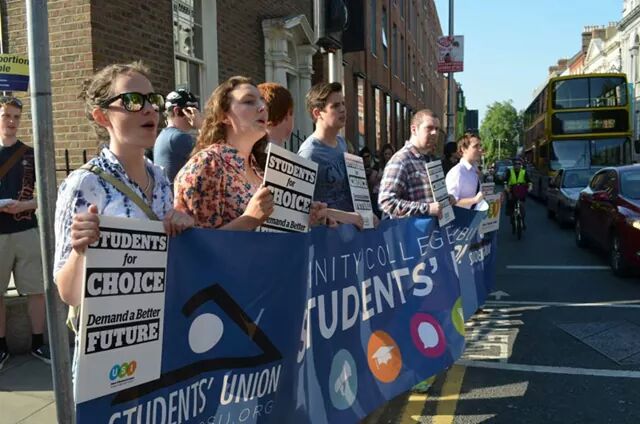
Abortion in Ireland has long been a topic of debate and discourse — particularly at Trinity. Abortion rights are an inevitable evolution in Irish electorate thinking regarding secularisation, globalisation, and a decline in the church’s power, leading to more liberal policies and laws. This hop, skip, and jump, as outlined in a somewhat linear fashion by many modern textbooks, is often an oversimplification of a complex movement that still has unfinished business in our fragile democracies.
One such lifelong advocate for abortion rights is Ivana Bacik, the current leader of the Labour Party and former Trinity law lecturer. In an interview with Misc. Magazine, Bacik outlined that her involvement in this movement was somewhat inspired by her mother, a “staunch feminist” who originally campaigned against the original Eighth Amendment in 1983. However, this pro-choice feminist stance taken by Bacik was not always met with praise; quite the opposite. As a student, almost immediately following her election as President of Trinity College Dublin Students´ Union (TCDSU) in 1989, she went to court along with the other SU sabbatical officers, where they were threatened with prison by the Society for the Protection of the Unborn Child for providing women with information on where to access abortion services in England.
Reflecting on that time, which must have been profoundly frightening and stressful not only as a young adult navigating the world but also as a woman in an oppressive religious and cultural context in Ireland, Ivana refused to buckle under the pressure. Ultimately, Mary Robinson stepped in, and her powerful arguments persuaded the Judge to refer the case to the European Court of Justice. Bacik, and others, were eventually spared prison time.
The radical nature of the SU activism last year under Laszlo Molnarfi was not the first time the SU has stood up for social justice causes and social change. Instead, it is part of a legacy of activists whose pathway was paved on Trinity’s campus. The separation between academic institutions like Trinity and activism is often blurred. Engaging in public discourse and debate is essential for developing critical thinkers and independent minds. Still, it also provides a hope that change on campus can lead to change elsewhere — that we can make our corner of the world better than we found it. While I do think it’s important to ‘hold space’ for criticism of the SU’s often superficial actions, it would seem that, by historical standards, they are at their best when their actions are not about ego but about voicing or taking the often brave actions that advocate for just and fair change.
This hope for the creation of a more just and fair society has been a catalyst for Bacik’s activism. It was the women who contacted the Union as a last resort to find information on how to access abortion that stayed with Ivana, and in her own words, “provided me with an enduring passion for human rights activism, along with a strong motivation to secure abortion rights for women”. Despite this passion, the road ahead was not easy for Bacik, as she described the experience of being spat at and abused in the street many times over those years. Despite such abuse, she stuck with her principles – and the campaign for abortion rights. She later went on to work on the national executive branch of the Together For Yes campaign, which finally succeeded in repealing the Eighth Amendment and legalising abortion in Ireland in 2018.
Yet this seemingly joyous occasion was sad for many involved in the campaign. Roe McDermott, a contributing writer for the Irish Times, reflected on that time by saying, “this pressure to perform unequivocal happiness was external, as comments such as “Get over it” were directed at women who expressed conflicted emotions.” For many women, such as Savita Halappanavar and other women who lost their lives to these oppressive laws or travelled miles often alone, this victory would come far too late. For many who still cannot access this healthcare, repeal remains too little and far too late.
An independent report conducted by Marie O’Shoe found that despite the repeal of the 8th Amendment, many pregnant people are still forced to travel to access terminations on medical grounds. The amendment’s narrow legal framework means many are still unable to access services when they need them. The 12-week provision of abortion is still seen by many to be far too restrictive, along with the three-day wait. Abortion access is described by the National Women’s Council (NWC) as a “postcode lottery”. This means that health professionals can still be prosecuted for providing abortion after this limit except under strict circumstances. This report was recommended and later endorsed by the NWC, repeating calls to increase the geographical coverage of abortion access and to make the three-day wait optional, among others.
While the fragmentation of left-wing parties is often the subject of debate – at least for the part of labour, Bacik expressed a clear intention to work closely with other left-wing parties to amend the current restrictions. Calling for a “pro-choice movement, and students’ unions should now launch a national campaign to pressure the Government to implement the review’s recommendations and ensure that we win these necessary changes for abortion rights in Ireland.”
However, given the recent chaotic scenes in the Dáil chamber during the election of the Taoiseach, students may prove to be a more reliable partner in the pursuit of justice than other political groupings in Leinster House. The left wing’s lack of cohesion not only acts against their self-interest in many ways but also harms the likelihood of ending 100 years of Fianna Fáil/Fine Gael governments — allegedly a stated aim but has no strategic follow-up. It seems clear that when Bacik suggested the left stick together in negotiations for the next government this request for cohesion and collaboration fell on deaf ears. So it will be interesting to see in the lifetime of the next government whether or not social justice issues prove to be a more unifying factor that brings cohesion.
For better or for worse, Trinity students throughout the years have used disruptive methods to pursue their political aims, and it seems when there is a cohesive fight for a particular aim, students of this college have more backbone or a better degree of clarity than the powers that be. While the sentiment of cohesion between the left is an arguably notable endeavour, if the encampment is anything to go by, real radical social change is best achieved in social movements on campus rather than in parliaments. Rather, they should reform cohesion-building power structures instead of combative ones that force alignment for parties of similar political persuasions.
In saying all this, I am reminded of a previous interview with Provost Linda Doyle for this same publication, in which she stated her strong preference for seeing a high turnout for SU elections across the board. More proportional turnouts to the entire student population would aid the SU’s legitimacy and better equip it to meaningfully engage with the issues of our time under a more concrete and robust mandate from the student body. Yet, perhaps, like the hopes of the left-wing parties to act as a united front, expecting the SU to reform in such a way is also wishful thinking.
Either way, the fight for women’s rights and equality over the past decades is far from over. While issues like abortion have been normalised (at least for now), there has been a clear evolution and shift in cultural values within the Ireland context. The role of university and student activism remains a critical symbol of social change and gives voice to a new generation. As Roe v. Wade demonstrates, these gains cannot be taken for granted; they must continue to be fought for. Yet this debate for far too many is settled. That spirit of activism around these issues that Bacik demonstrated so clearly during her time on campus has dwindled post-repeal. The question of the future of this movement remains unclear. However, one thing is sure for these campaigns to flourish on a national level, partnership will be critical to their success.

Leave a Reply