
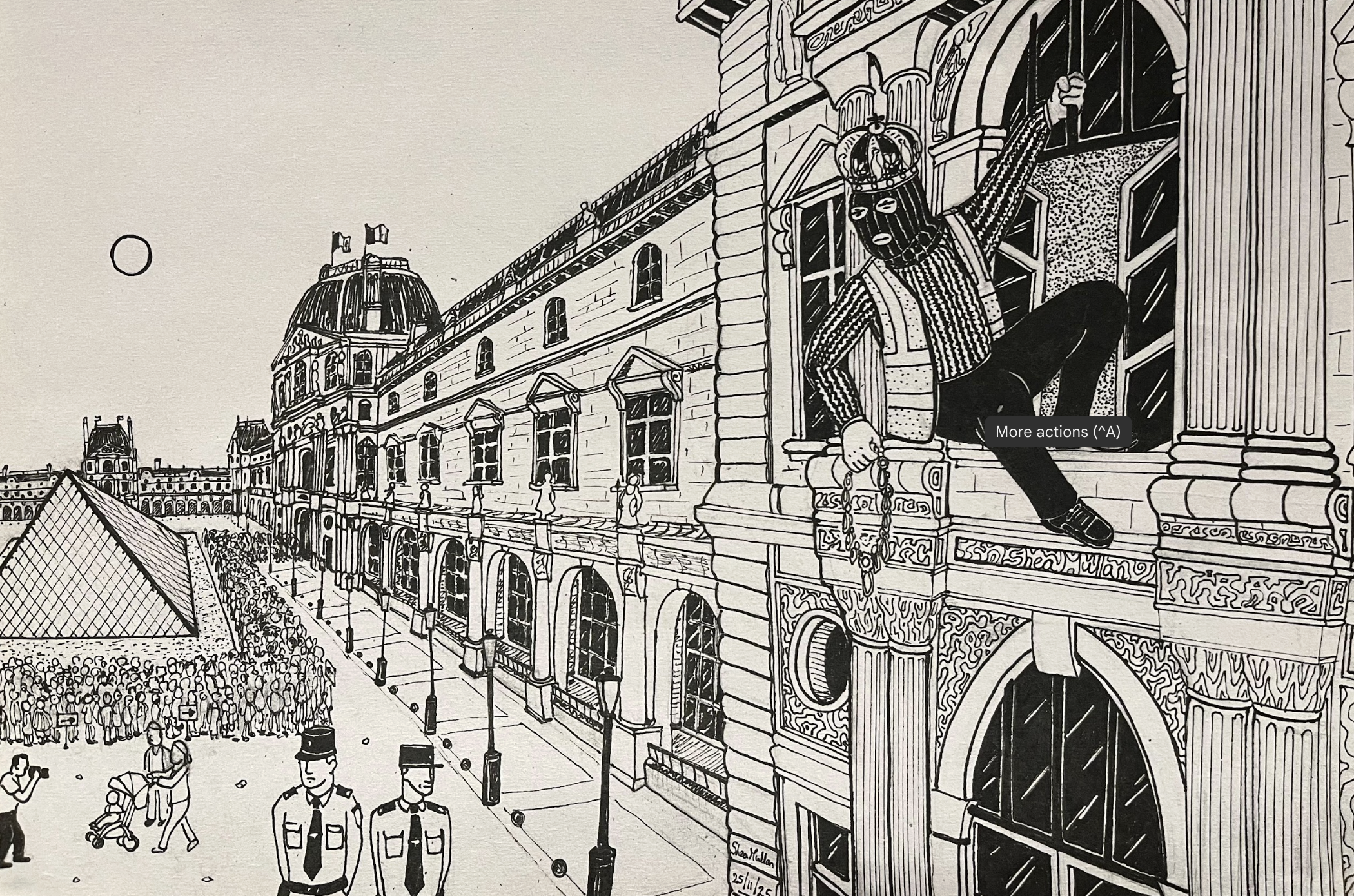
Paris has 136 museums, 400 independent bookstores, and a countless number of aspiring artists residing within its borders. The city has a rich history of creation. It has housed the pens of Ernest Hemingway, James Joyce, Oscar Wilde and Samuel Beckett. Pablo Picasso, Vincent Van Gogh and Henri Matisse found inspiration for their portraits amongst the vibrant culture of Parisian streets. The city cultivates an environment so grounded in art that it permeates each level of society. From museums to murals, metro posters to architecture, art is inescapable. The city of Paris privileges art in society, and an important element of such privileging is the choice to make this art accessible. In fact, art is so accessible in Paris that I’ve heard the Louvre lets you take it home with you for free!
Jokes aside, a simple walk to college, the metro or the local boulangerie reveals the beauty of a city that prioritises art and aesthetics. Wall art by popular French street artist Invader can be spotted in almost 1,500 locations in Paris. These colourful mosaics scattered around the city weave into the everyday lives of locals and tourists alike. Inspiring copycats, a mobile game, and a treasure-hunt-like following, Invader’s work brings art to the people, stretching beyond the confines of glass casings and barcode tickets.
A showing of art in Paris appears to me not only when I visit a world-famous museum, but also on my daily college commute. It surprised me how quickly I adjusted to the Parisian pace of living. 45-minute Dublin bus delays are nothing but a distant memory, and a mere 5-minute wait for the next line 10 metro had become a major disruption to my daily flow. That was, until I stopped to look around. At least once a week, my commute time lines up with the changing of the posters on the opposite platform. I look across the tracks to see RATP workers pasting a new poster atop layers of outdated advertisements. I enjoy watching this act of simultaneous concealment and revelation, but I prefer something that happens later in the evening, on my journey home. The pristine poster often falls into a manner of apparent disrepair in a matter of days, developing large tears. While some of these tears are the result of bored commuters picking at the edges on their way home or, in more extreme cases, anti-advertising activists, these rips often form interesting collages due to the layering of posters. This act of vandalism thus results in an act of art – be it intentional or not. It almost acts as a tribute to the French artist Jacques Villegé, who concentrated his work on building collages made from advertising posters he found on the street. The legacy of creation persists in a city of aesthetics.
In these ways, and many others, art in Paris expands beyond the boundaries of the Louvre complex or the walls of countless other museums in the city. Buskers on the street play jazz that inspires dancing just as much as the bands performing in famous jazz clubs like Caveau de la Huchette. Street artists in Montmartre create beautiful portraits in minutes. When art is everywhere, it becomes a shared experience, a shared resource. It proves that art is not just for the elite. Street art is a result of passion, a means of expression. Witnessing art in the everyday evokes the feeling of the Romantic poets who defined poetry as the “spontaneous overflow of powerful feelings”. What is art other than a necessity built from passion and emotion?
The city of Paris has made art extremely accessible to visitors. Many public institutions are free or cheap for students and young people, with most public museums being free to enter for EU citizens under the age of 26. While I won’t give away all of my student budget artistic life hacks at once, I will say that all forms of art, from paintings to opera performances, have never felt more easily accessible to me than they do in Paris. The choice to prioritise culture and access reflects the values of France as a nation of liberty, equality and fraternity. France allocated €8.32 billion to culture in its latest budget. While this only composes 1% of the overall budget, a sizeable influx of capital into the artistic sector allows it to continue to thrive.
In Paris, the individual is encouraged to become the curator. The sheer quantity of art that is on display requires the individual to make decisive choices. Do you spend your time standing in front of the works you have been told to respect the most, or do you find a small etching hidden away in a corner that leaves you engrossed for hours? Street art, contemporary art, impressionism, cubism, realism, neoclassicism, the list goes on. The exposition to so many different forms of art allows you to make your own choices about what you privilege. Art is political, as is the art you choose to engage with. Political discourse takes place on the walls of the Louvre in oils, as it does on the walls of poorer parts of the city, in the identities expressed in spray paint.
In Place de la République, protesters gather frequently to advocate for various causes. The monument in the centre of the square depicts Marianne, the personification of the French Republic. She is surrounded by statues representing equality, liberty and fraternity. In recent years, this monument has been covered with graffiti. Whether against the violence taking place in Gaza, the role of the police, or the violence of the far right, each time, the city of Paris cleans the white stone, effectively erasing the voices of its citizens. While Paris has strict laws against the vandalism of public monuments, it is important to acknowledge the nature of such vandalism. Parisians are using graffiti on symbolic monuments to express political outrage. Graffiti is, after all, a form of art, albeit one that does not receive the same privileges as traditional oil-on-canvas.
Non-institutional art helps to form the culture of a city. Cafes have long been established as social institutions that shape the societal, political and intellectual life of Paris. Important historical moments started over cups of coffee consumed in the “public sphere”. Different establishments became associated with different schools of artistic endeavours. Jean-Paul Sartre and Simone de Beauvoir frequented Cafe de Flore. Painters Claude Monet and Pierre Auguste Renoir preferred Café Guerbois in Montmartre. In contemporary life, cafe culture persists in Paris. People continue to frequent public forums, chasing the desire to participate in the theatre of urban life. However, with the rise of social media and the increasing authority of online life, how much of this participation comes from performance and the aestheticisation of experience? So often, people frequent institutions simply to take photographs for Instagram or film TikToks, rather than immersing themselves in a communal environment. It is sad to visit Monet’s Water Lilies and watch visitors view them through a screen.
In a world which increasingly decentres art, replacing analysis and interpretation with a rat race for views and engagement, it’s a refreshing experience to disconnect from the online world and live for the beauty of the real one. Engaging with art is an integral part of being human. It allows us to see through another’s eyes, learn from our history and reinterpret the present. It has persisted as a necessary human endeavour, and I hope that the prevalence of social media in our society does not erase the privilege of the public having easy access to art. After all, not everyone can get in and out of the Louvre in eight minutes.

Leave a Reply