
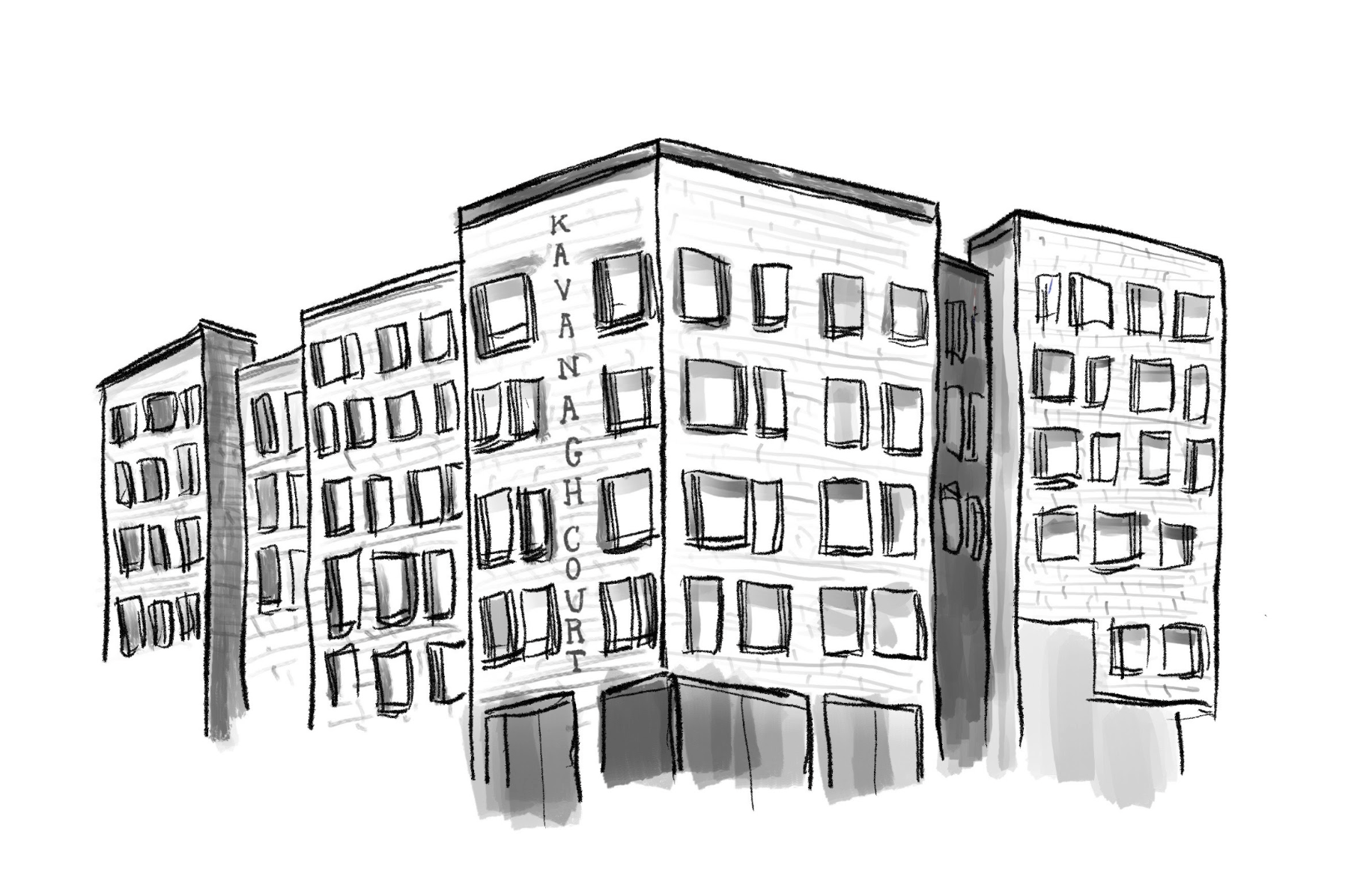
Amidst local antisocial behaviour issues, Kavanagh Court student accommodation has been the subject of ongoing discourse.
Kavanagh Court is finding itself at the forefront of an, understandably, negative conversation following recent issues of targeted antisocial behaviour toward students. However, despite this infamy, there is little discourse within Trinity that interests the area which many students call home beyond its antisocial issues. Kavanagh Court, or ‘Kav’, is almost always a second choice after the considerably cheaper Trinity Hall.
Kav is located within the ‘North East Inner City’, one of the most densely populated areas in Ireland with a long history of poor housing access and quality. With a 70% increase in population over the last 20 years, today the entire area’s ‘deprivation score’ is marginally above average.* This is because the area now contains both immense wealth and deprivation; despite often being viewed as rough, gritty, or dangerous – its first and foremost socioeconomically diverse. Notably, Kav is located at the tail end of one of four smaller areas, identified as some of the most disadvantaged areas in the whole country.
I have heard many describe Kav, usually in a coded manner, as a not-very-nice, poor area. However, any local who actually is poor will know very well that the area is not homogenous and extremely gentrified. Frankly, it irks me when people frame Kav and its locality as an undesirable place to live, because even though they may not like it themselves, demand shows the area is highly desirable.
I am not claiming that contextualising the targeted antisocial behaviour levied at Kav will prove it to be insignificant. In fact, its significance lies amongst a broader pattern of antisocial behaviour in the area. The 2023 Dublin Riots were a far more extreme example, where racism fuelled violence and looting in Dublin 1, leaving a scar on the area’s reputation. Posters in Kav have gone up with rally cries for greater policing and imploring residents not to interact with ‘local youths’. But what constitutes a local youth? Surely if we think of ‘local’ as describing residence in the area, Kav residents are themselves, ‘local youths’?
The University Times article reporting on the events used the same term, ‘local youths’ to describe the people engaging in this antisocial behaviour. During the 2023 riots, subsequent arrests proved that many people travelled from addresses far from Dublin 1 and treated the area as a playground for their antisocial inclinations. UT does not substantiate their claim of locality, and did not consult non-Kav residents for comment in their article. So, what really interests me is ensuring that this issue of antisocial behaviour is dealt with properly, and not utilised as a Trojan horse for inaccurate, classist, and patronising profiling of the area.
That won’t be done without Trinity students understanding that Kav is a part of gentrification, and doesn’t contribute to the long term improvement of the area. When Kav was built, these antisocial problems had been long embedded in the area, and locals had been crying out for positive investment in their area. There are community based services working to combat these issues holistically, such as youth clubs and mental health charities, however they have limited resources. If the government chooses to further invest in Garda presence in the area, this serves to tell locals, particularly poor locals, that surveillance is more important than care. I would encourage you now to imagine how it feels to grow up and live in the local area spending your life on the breadline, on waiting lists for the most basic needs of housing and healthcare – to then watch a ‘modern city centre student accommodation complex’ be built on your front door, with rents at €1300 a month, and understand that there is so much money in the world available for youths – just not ‘local youths’.
When identifying what is ‘local’, we must remember this is one of the most densely populated areas in the country, is easily accessible by public transport, and in parts, is profoundly under-resourced. When antisocial behaviour happens, proponents travelling in from nearby leafy suburbs can rest assured it will be blamed on the area not the action. So which came first, the antisocial behaviour or the under-resourced community? This issue is not going to be solved when it is blamed on locality and local people, and certainly not while solutions are being assumed without any nuanced understanding. Are these people deprived, radicalised, bored, enabled? Are students contributing to improvements in the area?
Bearing in mind Trinity’s student wealth divide, where roughly 35% of students are international students, 35% of Irish admissions are from ‘affluent’ backgrounds, and only 5-6% of Irish admissions are from socioeconomicly disadvantaged backgrounds, (where 18% is in line with population). I wholeheartedly believe that international students make up a more interesting and diverse social fabric of the college; but at present, that social fabric is plagued with gaping holes in the absence of a fair social mix of students.
Since starting at Trinity, I have been baffled at the way people talk about Kav and its locality. Before these incidents there was a palpable dissatisfaction with the area’s safety, and I understand it can be unpleasant to walk down Gardiner Street at night. But I have also personally seen the classist drivel which many deem acceptable discourse in college. I believe classism has driven a certain perception of the area which is simply disrespectful. Any real solution will have to start with Kav being able to work with other stakeholders in the community, instead of believing the community to be a sole cause and themselves, a sole victim.
Dr. Katriona O’Sullivan is both a Trinity graduate and someone who has lived in the area. Her book, ‘Poor’, describes her childhood growing up poor, living between England and Ireland. She shows just how hard it is to access education when you’re poor and describes, amongst so many other barriers, the classicism and stigma which is present across education and particularly in Trinity. The class mix of Trinity students has created this echo-chamber, a community where affluent students are an effective majority and students from poor backgrounds are artificially marginalised. For international students, Trinity’s admission system and the social mix it creates has given them an inaccurate view into the broader class landscape of Ireland and I believe in doing so, has enabled and fuelled classist rhetoric toward Dubliners. The recent antisocial issues were categorically abhorrent. Now, while the attention is on Kav, it’s time to interrogate and correct inaccurate rhetoric which fails to consider a complex locality.
If you’re living in private accommodation and have money to spare, I would really encourage researching and donating to initiatives in your local community. For Kav in particular, I would highly encourage donations to Belvedere Youth Club, who are doing extremely important work to support young people in the community. Students have limited power to change the institutional issues which plague this area, but we all have power over what words we encourage and tolerate. The stigma we can create or oppose has real material impact, and particularly in regards to Kav, needs some serious changing.
*This data is from Inner City Organisations Network’s website on the North East Inner City.

Leave a Reply