
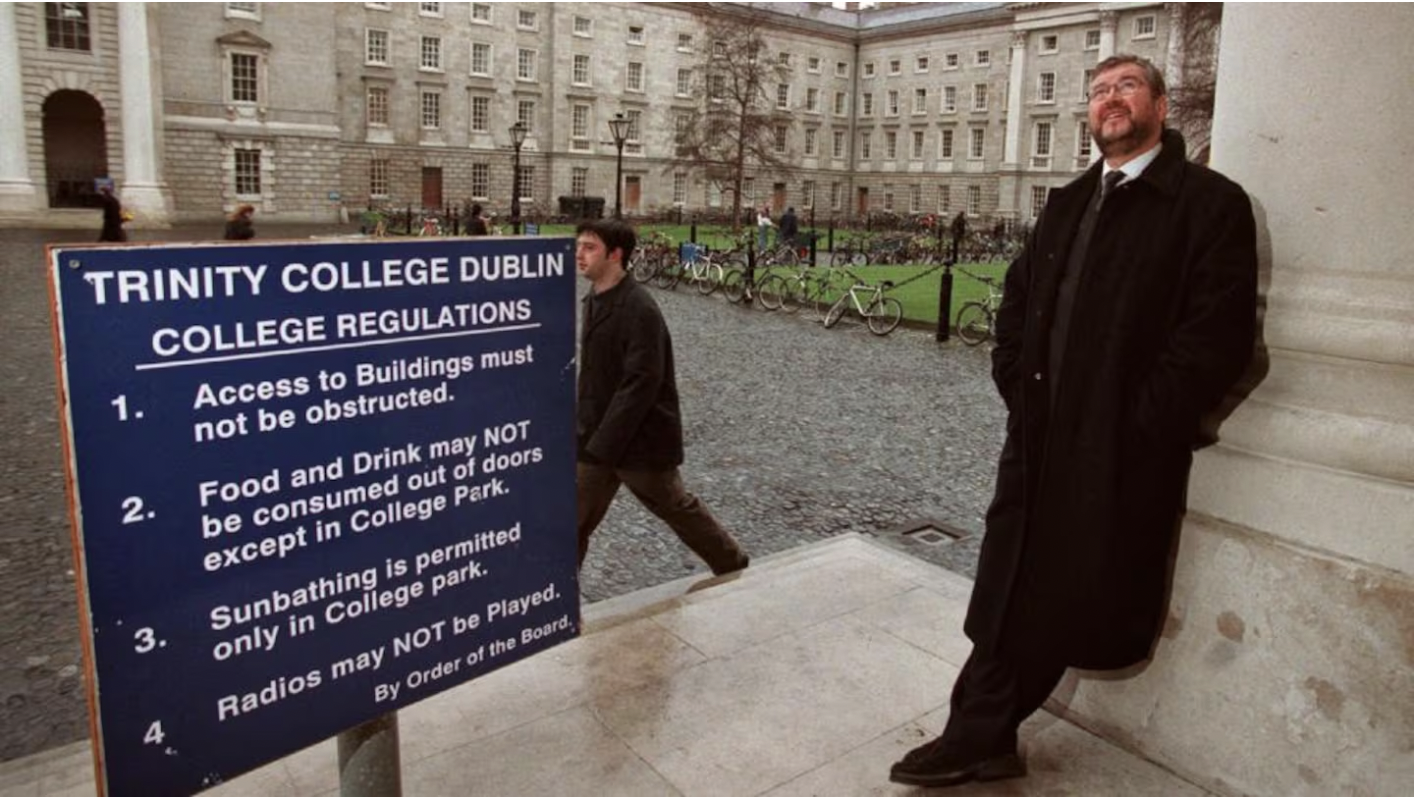
In the wake of a revival of student activism, the past of grass-roots action is beginning to resurface. From the successful BDS encampment last year to a constant presence of protest on campus, this revival demonstrates itself with an increased turnout and engagement, each SU election successfully outperforming the last. With unprecedented engagement, a culture of activism is once again finding its place on the campus of Trinity College Dublin. From going to a massively colonial institution to one that could be deemed a hub for left-wing activism, one might wonder: How on earth did we get here? From George Salmon to Linda Doyle, the progression seems profound, and I highly doubt you would think Joe Duffy had anything to do with it. This household name is famed for his history on RTÉ and “Live-Line,” a personal favourite of my mother. Regardless of your opinions on Live-Line, Duffy has a clear skill for platforming the people and making genuine change. This skill is likely to have formed on our campus in 1979.
Duffy began his time at Trinity in the late seventies, less than a decade after Catholics were permitted to enrol. He repeated two Leaving Cert subjects and worked for two years in publicity before his dream of studying at Trinity materialised. His very existence as a Catholic and being from Ballyfermot was radical enough. Duffy experienced a lot of confusion and alienation initially, which he dealt with by locking himself in the library. He was aware that he did not fit the status quo of the institution and scorned the elitist systems Trinity perpetuated. He maintains that third-level education felt like a ‘closely guarded secret treasure for the children of the rich’. He became known by many as “Joe Duffle” for the green duffle jacket he consistently adorned.
However, this put him in a position to criticise the college institution with precise accuracy, reflecting the changing attitudes and student body of the time. This began with a submission to the Irish Times in which he criticised Trinity’s introduction of the Nassau Street Gate, and as a result garnered publicity on campus. Duffy scorned this performative act, noting it did not change the fact “there is not one student in Trinity from the community directly behind it; the Westland Row, City Quay Parish.” The reception from this was enough for peers to suggest candidacy to him, and with that support, Duffy went for it.
Duffy likened his ticket to that of the Beatles – four working-class lads from all over the country who pooled their strengths in just the right way to emerge victorious. His campaign was not without controversy and involved interrupting lectures throughout campus, unknowingly bulldozing through norms. One of these was not to engage with Engineering students, who at the time were generally known to be hateful of left-wing student activists. His opposition to the status quo on campus permitted him to create something “fresh”, which aligned with his belief that access to education and so forth should be based on pure merit as opposed to class. Upon victory, a flag was hoisted by his ticket at the top of the Junior Common Room (now Regent House). Headlines reading “Ballyfermot Student Elected TCD SU President” permeated throughout the college; things were about to change.
Duffy’s time as president peaked with his boycott of catering services on campus. This emerged due to price increases on student meals, all the while commons was still subsidised. Support for the movement coincided with a rumour that someone had found a cockroach in the Buttery’s food, amidst claims that the food offered at the time was “disgusting.”.
This boycott did have one major drawback, though: the Pav would have to be included. Joe’s team reconciled this with the illegal idea of setting up their own bar in the Junior Common Room, attempting to evade the illegality by charging not for the alcohol but for the rent of the glass. The Guinness-only Pavilion Bar would now have a new competitor on campus: the Murphy’s-only, Joe Duffy-founded Junior Common Room Glass Rental.
Armed with a truck filled with kegs and an astute knowledge of the “secret” corridors of Regent House, this makeshift pub was created. Duffy described it as akin to a military operation, with disguises even being used at points during its set-up. He reconciled with the engineers, to whom he offered the first truck, which he mentioned was empty within the hour.
To evade capture, he and his committee would scream the head of security’s name to embarrass him, adorn the place with signs that read “Beer is not being sold here,” and set up various blockades.
The bar lasted for nearly a week. Trinity ultimately filed for a civil injunction in the High Court, which Duffy and others ignored. A week later, Gardaí entered the junior common room and arrested sixteen students, Duffy included. Upon attendance in the High Court, the judge refused to prosecute any students, concluding that Trinity needed to negotiate with the Student Union. Despite this brief imprisonment, the boycott emerged successful – TCD conceded to new menus and pricing options. In the midst of his celebrations, Duffy was asked by the then Buttery Manager if he would ever be satisfied with Trinity. He jokingly responded that he would stop when corporation housing was built on campus. Now, he supposes it is good enough to have students who grew up in corporation housing attending the university.
His presidency also led to the creation of “Community Week,” which posed as an alternative to “Trinity Week” at the time. He considered Trinity Week to be the pinnacle of the elitist institution—garden parties, fancy dinners, Elizabethan-style debates and a whole host of weird, ritualistic traditions. He created Community Week to be the antithesis of that: grass-roots and accessible. One of the publicity wars that Duffy won involved his proposal for a circus to take place on campus. Upon the rejection of the proposal, students went into uproar. Furthermore, he also led the boycott of the Provost’s election, the underlying motivation being that you were voting for a mere change in accent. He believed the board was still going to be an oligarchy of elitists and whatever symbolism it used to demonstrate its progress was bogus. Duffy similarly was very involved with his faith as a Catholic throughout his time at Trinity; he read at mass frequently and even read for the papal mass held upon the papal visit in 1979. He admits conspiracies—that he was some sort of papal-sent spy—were the beliefs of his opposition.
This caricature of Duffy as a thick-accented Catholic Dubliner with the intention to disrupt and stop at nothing for victory followed him throughout his career in student activism. Duffy was very aware of this in terms of who he engaged with. He had his confidants but remained cautious of partisan groups. In meeting one of the leaders of “Revolutionary Struggle,” whom he refers to as “Mark the Greek,” he noted that, while Mark worshipped him, he was nothing but a bumbling idealogue with no connection to reality. Duffy never was motivated by the fact that his activism would lead to a deafening blow for capitalism, and never organised with that in mind. This was also where his activism departed from the status quo of left-wing activism at the time; it didn’t have a basis in theory, but rather Duffy’s lived experience.
He explains that because of this, he and his SU posed a more fundamental threat to the university. Duffy’s and others’ shock with the “institutionalised privilege” in Trinity was entirely reasonable. The insular nature of Trinity, as it had been for four hundred years, was fraying, and its oligarchs were scared. The SU were charged with disciplinary proceedings from an uninterested provost for their uproar.
Duffy went on to have an even more controversial campaign in USI, littered with protests, imprisonments and injunctions. Despite this, he remained committed to broadening access to education and tackling the elitist culture and hierarchy that third-level education across the country contained. Duffy retains that Trinity probably still hates him and that he is happy about that. So, in the future, if you meet any dissenters of student activism who happen to adore Joe Duffy, you can call them hypocrites.

Leave a Reply