
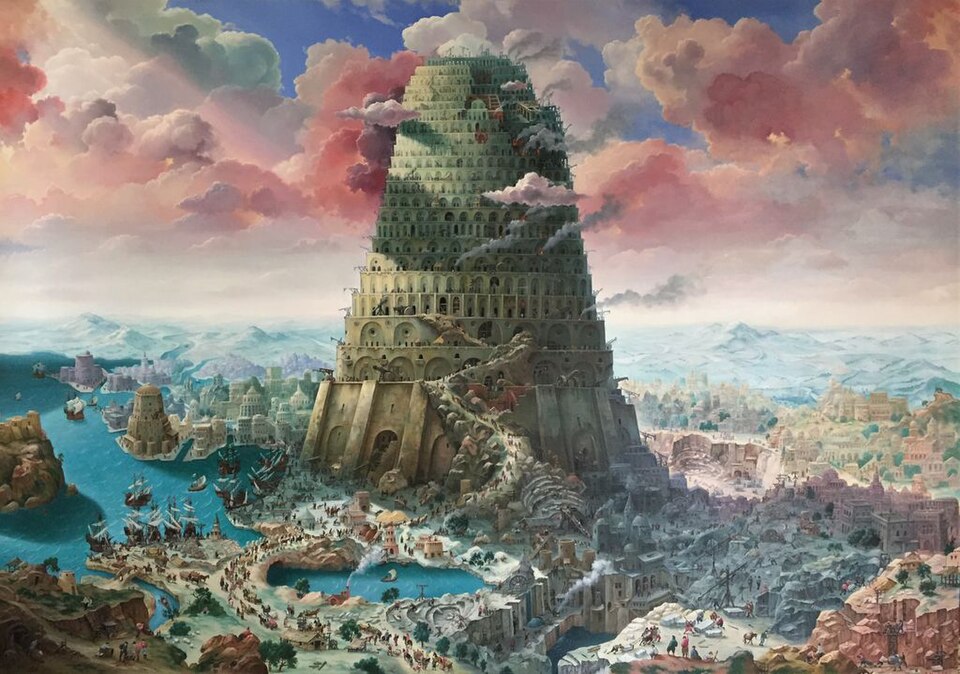
The Tower of Babel has more than seven thousand windows. Each and every one of them faces a different reality, where varied societies and cultures talk passionately about their day, about music and dancing, the food they prepared, the drinks they had, the stories they read, or the god they might believe in. Language is the window through which we see our world. Tongues are shaped in the mold of the community where they developed and evolved. The view that every society receives from their respective window is different. These windows might be fixed to face the same direction, but the collective view can never belong to the same reality, even if there are individuals that are able to walk through more than one of these landscapes (e.g. bilingual individuals, people that have a feeling of belonging towards more than one community, etc.). To speak in different languages is to shift between these realms. Translation is the art which makes it possible, the instrument to communicate between communities.
Ferdinand de Saussure established words as linguistic signifiers in the early twentieth century, a concept that positions words as passive descriptors of objective realities. But what if we saw words as more than just mere tools for portrayal? I understand words as seeing devices; consequently, languages shape the way we see. They, like eyes, allow us to grasp images, whether they are tangible or abstract. And because languages are shaped by their realities, the words in a specific vocabulary serve the distinct needs of those who speak them. That is why tongues are both the rock eroded by the wave and the wave that wears away the rock. Realities might not be able to be translated exactly (there is going to be some inevitable loss), but they can be brought closer. It is possible then to suggest translations that might be perceived as close, even if they are far from each other in a semantic sense. Similar, but not quite, like snowflakes appear to the human eye.
The language you speak in can influence so many things in your life, from the way you think to the way you understand the world and express your emotions. It can also affect how you decide to subconsciously or consciously portray yourself. I have been told that when I speak in Spanish, my native tongue, I seem bubbly, open, and approachable. I sense that my Spanish-speaking persona does not exactly translate into English, where I become someone more guarded, inconsistent, and awkward. I sometimes even realise it and try to change it, but usually it is not something I can easily manage. There are also times where I do not know this “deviation” is happening until I am alone feeling a little uneasy, so occasionally it can feel like an unstoppable force. This happens even though I have been studying and speaking English since I was three years old. When I am scared, sick, or upset, I always turn to Spanish. When I want to lean into my emotions, Spanish allows me to see the world from a more sensitive window. And when I want to run from them towards a less serious and more detached experience, I go to my English window. It has nothing to do with English per se, but the fact that it is not my mother tongue, which makes it emotionally foreign to me. Feelings are harder to translate than thoughts. Often words feel lacking when trying to express emotions, even in your own language. They have a sort of ineffable nature that makes them complicated in terms of precision, which is why trying to use a language that is not native to your feelings might feel weird and unnatural, almost like something artificial. Something of an act or a performance. Nevertheless, sometimes not speaking in your mother tongue can offer a particular distance that can be convenient when being vulnerable.
The way we speak our languages and the words available to us impact both our critical thinking and the way we identify ourselves. In George Orwell’s 1984, a novel that heavily critiques totalitarian regimes, this idea is explored when words like “freedom” are completely erased from the English language by “the Party,” the authoritarian organization running the novel’s society. What Orwell essentially demonstrates is that if there are no words to express something, then it cannot potentially exist. It is difficult, if not impossible, to think about a concept or idea that does not have a linguistic signifier. Language is the window through which we see our world, but if there are no words to articulate it, the vision of the world turns blurry and unfocused, making it hard for us to see these realities we crave to describe. Complex concepts like freedom, equality or ethics are difficult to even think about if language is not there to be the riverbed of our thoughts. Words, or rather a lack of them, can affect identity too. Under the Trump Administration, words charged with values or politics that the MAGA right disagrees with have become increasingly endangered. To give an example, Trump stated the following in January 2025: “it will henceforth be the official policy of the United States government that there are only two genders, male and female,” affecting all queer identities in the country, forcing them to oblige to gender binarism and transphobic norms, plus intersex-erasure, in official documentation. Because the words we use matter, and language allows expression of existence, what you ban in linguistic terms, you ban in real life too.
Like I said, the Tower of Babel has more than seven thousand windows, but it has even more inhabitants, around 8.3 billion to be more precise. Maintaining the language landscape the world’s speakers and societies have to offer is imperative, even more so in the face of governments that are trying to destroy or neglect them. When the window gets blurred, and the view is obstructed, trying to look into certain realities will become more difficult. To destroy this linguistic diversity, eventually, will dent the identities of all humankind, especially those that belong to marginalised language communities.

Leave a Reply